Gửi bình luận
Hủy
Gửi
Thur, 22/10/2026

DOI: https://doi.org/10.70786/PTOJ.2026.3918
Abstract: The United Nations is the world's largest multilateral organization with the mission of maintaining international peace and security and promoting friendly cooperation and development among countries around the world. The achievements in the cooperative relationship between Vietnam and the United Nations are enormous, affirming that Vietnam is an active and responsible member of the international community in general, a member state of the United Nations in particular, while also contributing to enhancing the role and position of Vietnam in the international arena. This article clarifies Vietnam's participation and contribution to the United Nations since its accession to the present.
Assoc.Prof.,Dr. PHAN VAN RAN
Institute of Politics and International Relations,
Ho Chi Minh National Academy of Politics
1. Introduction
The United Nations (UN) was established on October 24, 1945, at the San Francisco Conference with the participation of representatives of 51 countries at the initiative of the Soviet Union, the United States and the United Kingdom. Established in the context of humanity having just suffered the severe consequences of World War II (1939-1945), the UN determined its purpose as maintaining international peace and security; promoting friendly relations between countries, cooperation and development; acting as a center to coordinate international efforts for the common goals of humanity. It operates according to five main principles: 1. Equality of national sovereignty; 2. Respect for the territorial integrity and political independence of countries; 3. Settling international disputes by peaceful means; 4. Non-interference in the internal affairs of countries; 5. Respect for international obligations and laws(1).
With the above-mentioned progressive purposes and principles of operation, after nearly 8 decades of existence and development in the context of a complex global situation and the impact of many different factors, the UN has played a very active role in maintaining international peace and security; enhancing understanding and friendly relations among member countries; promoting socio-economic cooperation and democratizing global political life; demonstrating the determination to lift the world out of poverty and backwardness and towards prosperous development, and so on.
Vietnam has always appreciated the role of the United Nations in the daily life of the international community. Therefore, not long after the country gained independence, on January 14, 1946, President Ho Chi Minh sent a letter to the representatives of the Soviet Union, the United Kingdom, and the United States at the United Nations, requesting that these countries recognize Vietnam’s independence and admit Vietnam into the United Nations: “Our people have won and maintained independence and earnestly request that you all recognize that independence and admit us into the United Nations”(2). However, due to many different reasons, it was not until the country was unified (in 1975), by its own right, that Vietnam became an official member of the United Nations on September 20, 1977. The Vietnam - UN relationship is divided into two main periods: the period before 1991 and the period from 1991 to the present.
2. Vietnam - United Nations relations before 1991
Immediately after joining the UN, Vietnam proactively cooperated with the UN through activities such as mobilizing and enlisting member countries of the UN General Assembly to pass Resolution A/Res/33/2(1977); calling on the international community to provide aid and help Vietnam rebuild and heal the wounds of war; strengthening solidarity and cooperation with democratic and socially progressive forces of member countries, taking advantage of favorable international conditions, including receiving assistance in terms of capital and science and technology from the UN to serve Vietnam’s cause of national construction and development.
Vietnam has also actively and proactively coordinated with countries in the Non-Aligned Movement and developing countries to fight to protect the basic principles of the UN Charter such as the principles of sovereign equality, non-interference in each other’s internal affairs, non-use or threat of the use of force, and at the same time protect the interests of developing countries, including Vietnam. Along with that, Vietnam has always proactively raised its voice in strong support of issues related to peace, stability, and cooperation in Southeast Asia, actively working with member countries to urge the UN to adopt resolutions, decisions, and specific measures to promote the role of the UN, strengthen the coordination of countries in the fight against the arms race, disarmament, prevention and resolution of international disputes and conflicts by peaceful means, protecting the independence and self-determination of countries, and so on.
However, after the Vietnamese volunteer army entered Cambodia (in early 1979) in response to the call for help from the Cambodian National United Front for National Salvation to overthrow the Pol Pot genocidal regime, the United States, Western countries, China, and ASEAN used the UN to legitimize the Democratic Kampuchean government against the People’s Republic of Kampuchea and against Vietnam. They also sought to bring the issue of Vietnam’s intervention in Cambodia under the heading of “The situation in Cambodia” and “The issue of the Vietnam-China border dispute” to the General Assembly and the UN Security Council. In that context, Vietnam’s activities at the UN from 1979 to 1990 were mainly aimed at resolving the Cambodian issue, advocating for a peaceful resolution of Cambodia’s issues outside the UN, and promoting Vietnam’s just stance in saving the Cambodian people from the genocidal regime. With the signing of the Paris Agreement in 1991 on the issue of peace in Cambodia, Vietnam’s difficult and complicated period at the UN also came to an end.
In general, due to the impact of the Cold War and the ideological struggle between two opposing social systems, the relationship between Vietnam and the UN before 1991 faced many difficulties and complications. Under conditions of embargo and prolonged isolation, Vietnam’s role and position at the UN during that time were very modest. However, Vietnam still managed to take advantage of some non-refundable direct aid from the UN Development System and specialized UN organizations, contributing to overcoming the consequences of war and solving socio-economic difficulties, natural disasters, epidemics, and so on.
3. Vietnam - United Nations relations from 1991 to the present
Policy of expanding and strengthening relations with the United Nations
In the late 80s and early 90s of the 20th century, the world situation witnessed significant changes. The socialist regimes in the Eastern European countries and the Soviet Union collapsed, the Soviet Union disintegrated, and the bipolar world order headed by the two superpowers, the Soviet Union and the United States, ended. The era’s contradiction between socialism and capitalism continued to exist, but it was no longer the leading or sole factor shaping cooperation and alliances among countries, which were now increasingly driven by national and ethnic interests. In this context, Vietnam advocated implementing the policy of renovation, implementing a foreign policy of “making more friends, reducing enemies”, “making every effort to break the embargo, winning as many friends as possible, and reducing as many enemies as possible”.
In the field of multilateral diplomacy, the 6th National Party Congress emphasized the policy of “expanding relations with international organizations”(3), including the United Nations. The 7th Congress set forth the foreign policy on “independence, self-reliance, diversification, and multilateralization of international relations”. Regarding multilateral diplomacy, the 7th Congress determined that the task of foreign affairs is to “contribute step by step to making the United Nations effectively serve the goals of humanity: peace, friendship, cooperation and development. Cooperate with international financial and monetary organizations as well as specialized organizations of the United Nations and non-governmental organizations”(4).
It can be said that since 1991, in multilateral diplomatic activities, Vietnam has continuously attached importance to cooperative relations with the UN in general and the UN’s specialized agencies in particular, marking a new development step in Vietnam’s foreign policy, in line with the globalization process after the Cold War, while meeting Vietnam’s development requirements in the new context.
Continuing to supplement and develop the foreign policy in the renovation period, the 8th Congress set forth the motto “Vietnam is ready to be a friend of all countries in the global community, striving for peace, independence and development”(5). In multilateral diplomacy, our Party emphasized: “strengthening relations with organizations of the United Nations and other organizations. Actively operating in international forums, participating in solving global issues. Supporting the struggle to eliminate nuclear weapons and means of mass destruction”(6). This issue was further affirmed at the 9th and 10th Congresses with the motto “Vietnam is a friend and reliable partner of all countries in the international community, actively participating in the process of international and regional cooperation”(7).
The 11th Congress proposed the policy of expanding foreign affairs activities, proactively and actively integrating into the international community, focusing on “Participating in bilateral and multilateral political and security cooperation mechanisms for national interests on the basis of respecting the fundamental principles of international law and the United Nations Charter. Performing well in the work of international organizations, especially the United Nations”(8). Thus, for the first time, the UN was mentioned by the 11th Congress of the Party in the direction of implementing Vietnam’s foreign affairs tasks. This was the result of Vietnam’s fairly extensive participation in UN activities.
The 12th Congress clearly stated the orientation to improve the quality and effectiveness of multilateral foreign affairs: “Proactively and actively participate in multilateral mechanisms on national defense and security, including participation in higher-level cooperation activities such as United Nations peacekeeping operations, non-traditional security exercises and other activities”(9). The 13th Congress emphasized “Ensuring the highest national interests on the basis of the fundamental principles of the United Nations Charter and international law, equality, cooperation, and mutual benefit”(10). This evidence shows that Vietnam respects and upholds the principles of the United Nations Charter. The 13th Congress continued to emphasize that strengthening cooperation with the United Nations is one of the priority directions in multilateral diplomacy: “Proactively participate in and promote Vietnam’s role in multilateral mechanisms, especially ASEAN, the United Nations, APEC, Mekong sub-regional cooperation and regional and international cooperation frameworks, in important issues and mechanisms of strategic significance, in accordance with specific requirements, capabilities and conditions”(11). It can be seen that Vietnam’s consistent policy is to promote its role in UN mechanisms, identifying the UN as a high-priority partner in Vietnam’s multilateral foreign policy. At the meeting with the UN Secretary-General on September 25, 2024, General Secretary and President To Lam affirmed: “The United Nations plays an increasingly important role in global governance, promoting multilateral cooperation, upholding international law, helping to bridge gaps and promote development, ensuring the full participation of all countries”(12).
Vietnam’s contributions to the United Nations
Firstly, proactive participation in the United Nations’ policy-making mechanisms
Vietnam’s multilateral diplomatic activities at the UN have been actively, proactively and comprehensively implemented, creating remarkable impressions. During the period 1991-1996, Vietnam’s multilateral diplomatic activities at the UN were still passive, mainly accepting the rules of the game. Since 1997, Vietnam has begun to participate in the UN’s policy-making mechanisms such as: Vice President of the UN General Assembly in 1997, and member of the Economic and Social Council for the 1998-2000 term. In particular, since the beginning of the 21st century, Vietnam has proactively put forward many initiatives, actively coordinated with UN organizations to pilot the “One United Nations” Initiative in Vietnam. Vietnam is one of the first eight countries in the world selected by the United Nations to pilot the Initiative with the aim of implementing a program to reform the apparatus of UN representative agencies in countries toward a more streamlined and effective structure. The results achieved in the implementation of this Initiative affirm Vietnam’s contribution to the UN reform process, further tightening the long-term relationship and mutual trust between Vietnam and the United Nations.
One of Vietnam’s outstanding contributions to the United Nations is that Vietnam has successfully fulfilled its mission as a non-permanent member of the United Nations Security Council for the 2008-2009 and 2020-2021 terms. During the 2008-2009 term, as President of the United Nations Security Council in July 2008, Vietnam organized and chaired an open discussion on the topic “Children and armed conflict” at the Security Council. This initiative was highly appreciated by countries, demonstrating Vietnam’s responsible and substantive contribution to the United Nations. In October 2009, Vietnam led the drafting and negotiation process to help the United Nations Security Council adopt Resolution 1889 on Women, Peace and Security - one of the four important documents of the Security Council in this field.
During the 2020-2021 term, Vietnam proactively participated in contributing to the common work of the United Nations in the spirit of independence, self-reliance, positivity, and responsibility, while promoting bilateral relations with member countries of the United Nations Security Council. As the President of the United Nations Security Council in January 2020, Vietnam chaired the open ministerial discussion on the topic “Promoting compliance with the United Nations Charter to maintain international peace and security” and adopted the Presidential Statement on the United Nations Charter. Also during this month, Vietnam continued to chair the meeting on the topic “Cooperation between the United Nations and ASEAN in maintaining international peace and security”. This was the first forum for exchange and cooperation between the United Nations Security Council and ASEAN. This initiative promoted the role of the United Nations, in line with ASEAN’s expectations, promoting ASEAN’s central role in the security architecture of the Asia-Pacific region.
As the President of the Security Council in April 2021, Vietnam organized, chaired, and led about 30 meetings, including a high-level open discussion organized on April 19, 2021, on the theme “Strengthening cooperation between the United Nations and regional organizations in promoting trust and dialogue in preventing and resolving conflicts”. This is the first time a senior Vietnamese leader chaired an important event at the UN Security Council. This event promoted cooperation between the UN and ASEAN, promoting the role of the UN in maintaining peace and preventing conflicts in the East Sea region.
In 2020, Vietnam and Germany proposed the establishment of the Group of Friends of the United Nations Convention on the Law of the Sea (GoF UNCLOS) in response to challenges regarding sovereignty over seas and islands. Subsequently, they, along with Germany and many other countries, advocated for the group’s establishment. By June 2021, the group was officially launched with 96 participating member countries (by May 2023, the number of members of the group increased to 115 countries)(13). The Group of Friends of the United Nations Convention on the Law of the Sea plays a role in promoting ocean governance and maritime security in general and contributing to the early and proactive safeguarding of Vietnam’s maritime and island sovereignty in particular.
Additionally, since the beginning of the 21st century, Vietnam has been elected multiple times to important positions in numerous specialized agencies of the United Nations such as the Human Rights Council for the 2014-2016 and 2023-2025 terms, the United Nations Economic and Social Council for the 2016-2018 term; twice held the position of member of the United Nations International Law Commission for the 2017-2022 and 2023-2027 terms; Vice President of the 77th UN General Assembly; Vice President of the 42nd UNESCO General Assembly (2023); member of the World Heritage Committee for the 2015-2019 and 2023-2027 terms, and so on.
In these roles, Vietnam has proactively promoted the relationship between the UN and many other international organizations as well as the relationship between UN member states, thereby contributing to raising Vietnam’s voice on many international issues, protecting the legitimate interests of the country, promoting the country’s development, and enhancing Vietnam’s position in the international arena.
With these significant contributions, the UN recognized that in recent years, Vietnam has transformed from a country receiving support from the UN to a country with a growing capacity, strongly contributing to the UN’s cooperation mechanisms(14). UN Secretary-General Guterres “thanked and highly appreciated Vietnam’s active participation and contributions in important agencies, as well as in all priority areas of the UN, especially in peacekeeping, implementing the Sustainable Development Goals, responding to climate change, and making a fair energy transition”(15).
Secondly, contributions to the field of international peacekeeping and security
Security is one of the areas that Vietnam pays special attention to in its cooperation with the UN and has gained positive results. Right from the early years of renovation, Vietnam actively participated in the negotiation process and became a member of the Chemical Weapons Convention (1998), signed the Comprehensive Nuclear Test Ban Treaty - CTBT (1996); became a member of the Conference on Disarmament (1996), and signed the Additional Protocol to the Nuclear Safeguards Agreement with the IAEA. Every year, Vietnam regularly participates in the UN Conventional Weapons Inspection Mechanism to implement one of the measures to build trust with countries and fulfill its obligations as a UN member. Vietnam has also proactively and actively coordinated with Non-Aligned and developing countries to fight to protect the basic principles of the UN Charter and international law, strive for a fair and equal international political and economic order, and protect the interests of developing countries.
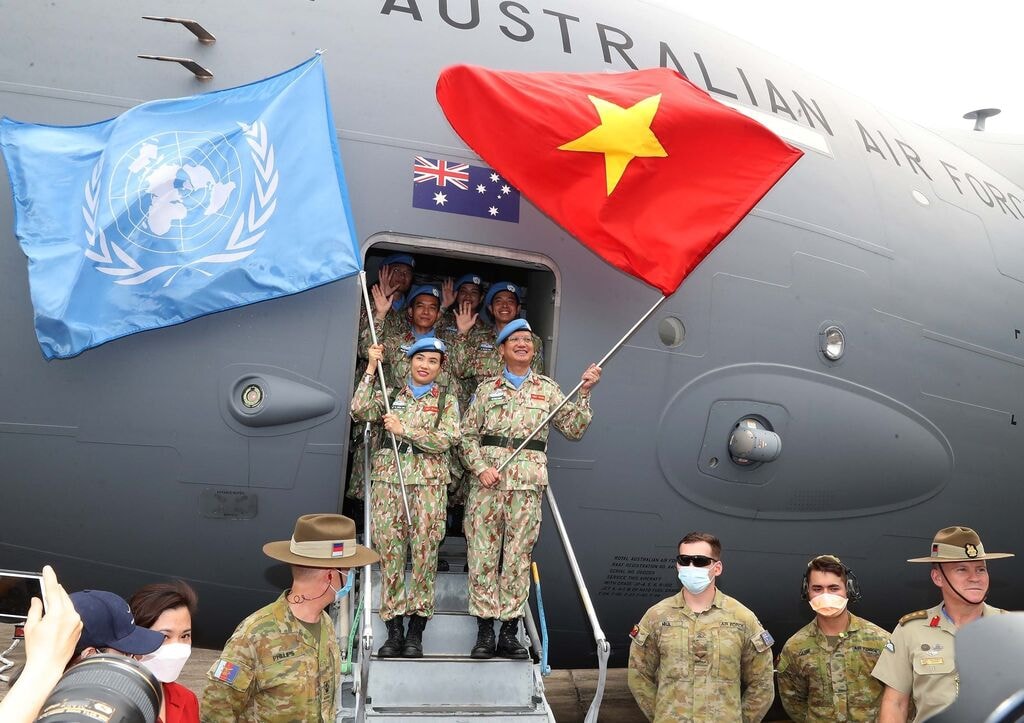
Vietnam is also an active participant in UN peacekeeping operations. To carry out this task, in May 2014, Vietnam established the Vietnam Peacekeeping Center (renamed the Vietnam Peacekeeping Department in 2018) under the Ministry of National Defense. In June 2014, Vietnam sent its first troops to participate in UN peacekeeping operations and by May 2024, Vietnam had sent more than 800 military personnel to participate in peacekeeping operations in South Sudan, the Central African Republic, Abyei, and at the UN Headquarters(16). Along with this, at the end of 2014, Level 2 Field Hospital No. 1 was established and by October 2018, 63 members departed for a mission in South Sudan, taking over the UK’s Level 2 Field Hospital. This was Vietnam’s first ever unit-level participation in UN peacekeeping operations. By July 2024, Vietnam had deployed Level 2 Field Hospital No. 5 in South Sudan. In addition, Vietnam also sent two engineering teams (each team includes 184 officers and staff) to perform UN missions in Abyei, a disputed area between Sudan and South Sudan. Through these activities, the engineering units have made positive impressions among the international community and especially the people of Abyei, showcasing the image of a friendly, responsible, and noble Vietnam.
In addition to deploying troops to UN peacekeeping forces, Vietnam is also an important training location for UN peacekeeping forces. The Vietnam Peacekeeping Department was selected by the UN as one of four Asian centers to conduct tripartite training courses (including the UN, troop-contributing countries and supporting member countries). From 2018 to the present, Vietnam has been selected as the place to organize 3 training courses for forces participating in UN peacekeeping missions within the framework of the Tripartite Partnership Program. In 2020, Vietnam assumed the position of Chair of the Association of Asia-Pacific Peacekeeping Centers (AAPTC). In June 2022, Vietnam successfully organized the AAPTC Conference with 18 countries and 8 international organizations attending in person in Hanoi. In addition, in 2020, for the first time, Vietnam was honored with assuming the role of Chair of the ASEAN Peacekeeping Centers Network (APCN). As Chair of APCN, Vietnam successfully organized the APCN Conference online in 2020 and successfully organized the APCN Conference in 2023.
Cooperation in the security field between Vietnam and the United Nations has achieved many positive results and is a bright spot in Vietnam’s multilateral diplomacy at the United Nations, reflecting Vietnam’s positive contributions.
Thirdly, Vietnam’s contributions in the field of development cooperation
In 2000, the United Nations held the Millennium Summit and adopted the Millennium Declaration with 8 Goals and 21 specific targets, unanimously striving to achieve them by 2015. Vietnam is considered by the United Nations and the international community to be a leading country among developing countries in hunger eradication, poverty reduction, and the implementation of the Millennium Development Goals (MDGs) set by the United Nations. In 2005, Vietnam approved the new core program of the United Nations in Vietnam (UNDAF) and programs to improve aid effectiveness, notably the Hanoi Commitment on aid effectiveness, the Action Plan on harmonizing aid procedures in Vietnam. In particular, the priority direction between Vietnam and UN organizations is demonstrated by achieving the 3 main goals stated in UNDAF: building economic policies supporting equitable, inclusive, and sustainable growth; improving the quality of social services and social security, and equity in access to these services; and policies, laws, and national governance structures that effectively support development based on rights to achieve MDGs and associated values, and so on.
With good relations and confidence in Vietnam’s future development, the UN has provided significant aid to Vietnam. In the context of the country’s difficulties and limited resources, the UN’s financial support has made an important contribution to Vietnam’s socio-economic development.
In 2015, the United Nations adopted 17 Sustainable Development Goals (SDGs). After a period of preparation, in May 2017, Vietnam issued the National Action Plan to implement the 2030 Agenda for Sustainable Development with 17 general goals and 115 specific goals, suitable to the development conditions and context of Vietnam. Vietnam is considered by the United Nations and the international community as a successful example in implementing the SDGs, a country determined and serious in implementing the 2030 Agenda for Sustainable Development.
Vietnam has expanded its cooperation with the Food and Agriculture Organization of the United Nations (FAO). Since 1986, FAO has participated in hundreds of projects in Vietnam, focusing on supporting sustainable agricultural development, food security and nutrition, forestry and fisheries, contributing to promoting agricultural production in Vietnam. In particular, Vietnam has cooperated with FAO to support many African countries in agricultural development under the UN-led South-South cooperation program (tripartite cooperation), sending many agricultural experts to support the countries of Congo, Benin, Angola, and Mozambique, contributing to hunger eradication and poverty reduction in these countries.
4. Conclusion
The United Nations has always held an important position in the multilateral foreign policy of the Party and the State of Vietnam. Since becoming an official member of the United Nations (in 1977), especially from 1991, Vietnam has always attached great importance to the role of the United Nations in maintaining international peace and security, promoting the development of countries; affirming its respect for the principles of the United Nations Charter in resolving international conflicts. On the basis of the existing strong relationship, the increasing comprehensive strength of Vietnam, and the growing number of global issues..., the Vietnam - UN cooperation relationship will certainly develop even more strongly in the coming time, bringing benefits to both sides in particular and the world community in general.
_________________
Received: October 10, 2024; Revised: November 3, 2024; Approved for publication: November 20, 2024.
Author’s email: ranphanvan@yahoo.com.vn
Endnotes:
(1) United Nations: United Nations Charter, Chapter I: Purposes and Principles, https://www.un.org, accessed July 15, 2024.
(2) Ho Chi Minh: Complete Works, vol. 4, National Political Publishing House, Hanoi, 2011, p.180.
(3), (4), (6) Communist Party of Vietnam: Documents of the Party Congress in the renovation period, vol. I, National Political Publishing House, Hanoi, 2019, pp.80, 411, 656.
(5) Communist Party of Vietnam: Documents of the 8th National Congress of Delegates, National Political Publishing House, Hanoi, 1996, p.120.
(7) Communist Party of Vietnam: Documents of the 10th National Congress of Delegates, National Political Publishing House, Hanoi, 2006, p.112.
(8) Communist Party of Vietnam: Documents of the 11th National Congress of Delegates, National Political Publishing House, Hanoi, 2011, p.236.
(9) Communist Party of Vietnam: Documents of the 12th National Congress of Delegates, National Political Publishing House, Hanoi, 2016, pp.155-156.
(10), (11) Communist Party of Vietnam: Documents of the 13th National Congress of Delegates, vol. I, National Political Publishing House, Hanoi, 2021, pp. 161-162, 162-163.
(12), (15) Van Hieu: General Secretary and President To Lam meets with the Secretary General of the United Nations, https://vov.vn, posted on September 25, 2024.
(13) Chu Van: The Group of Friends of the 1982 United Nations Convention on the Law of the Sea agreed to continue promoting multilateralism and international cooperation”, https://baoquocte.vn.
(14) Ngoc Anh: Vietnam is a responsible member of the United Nations, https://www.xaydungdang.org.vn, 21-9-2023.
(16) Huu Duong, Trung Thanh: Imprints of the 10-year journey of Vietnam’s peacekeeping force, People’s Army, https://www.qdnd.vn, posted on May 27, 2024.
(17) Dang Dinh Quy (editor-in-chief): Multilateralism in the world and Vietnam’s multilateral foreign affairs, National Political Publishing House, Hanoi, 2019, p.282.

Under supervisory of: Ho Chi Minh National Academy of Politics
Editor in Chief: Assoc. Prof., Dr. Nguyen Thang Loi