
Gửi bình luận
Hủy
Gửi
Mon, 19/10/2026

Abstract: The conclusions of the Politburo, the Secretariat, and the Resolutions of the National Assembly and the National Assembly Standing Committee have opened a major direction for renovation in the organization and operation of local governments according to the two-level local government model from July 1, 2025. After the first month of implementation, the results achieved are enormous, demonstrating the wisdom, correctness, and timeliness of our Party and State. However, there are still a number of issues that need to be further resolved to ensure the two-level local government model operates smoothly and effectively, especially at the grassroots level, which must proactively grasp and manage the socio-economy, national defense, and security.
Assoc. Prof., Dr. NGUYEN MINH PHUONG
Academy of Public Administration and Management
MA. NGUYEN THI THIEU HUONG
Thuong Hong Ward Party Committee, Hung Yen Province
1. Introduction
The demarcation of administrative-territorial units and the organization of 3-level local government (province - district - commune) in our country in recent times has achieved many important results, contributing to political stability and socio-economic development. However, in the face of the country’s new development requirements, the local government organization model has revealed certain limitations and inadequacies. Therefore, the rearrangement of provincial and commune-level administrative units and the implementation of the two-level local government model are a national-level administrative reform of great magnitude, creating a new development space; a turning point in comprehensive restructuring to build a streamlined, modern administration, capable of seizing opportunities in the new era.
2. Content
2.1. Overview of the implementation of the two-level local government model
Conclusion No. 126-KL/TW dated February 14, 2025, of the Politburo and the Secretariat on a number of issues and tasks to continue to arrange and streamline the organizational apparatus of the political system in 2025; Conclusion No. 127-KL/TW dated February 28, 2025, of the Politburo and the Secretariat on implementing research and proposals to continue to arrange the organizational apparatus of the political system; Conclusion No. 137-KL/TW dated March 28, 2025, of the Politburo and the Secretariat on the Project to arrange and reorganize administrative units at all levels and build a model of organizing two-level local governments, have opened a major orientation for the organization and operation of local governments in the context of preparing all conditions and mindsets for the country to enter a new era of development, prosperity and sustainability.
Institutionalizing the guiding viewpoints of the Party Central Committee, the Politburo, and the Secretariat on organizing local governments according to the two-level model, the National Assembly passed Resolution No. 203/2025/QH15 dated June 16, 2025 on amending and supplementing a number of articles of the 2013 Constitution and the Law on Organization of Local Government No. 72/2025/QH15 dated June 16, 2025, Law on Cadres and Civil Servants No. 80/2025/QH15 dated June 24, 2025; the National Assembly and the National Assembly Standing Committee issued resolutions on the arrangement of provincial and commune-level administrative units. Accordingly, the functions, tasks, and powers of local governments at the provincial and commune levels (after the end of the operation of district-level administrative units from July 1, 2025) are defined as follows:
For the provincial level: this is the level that performs general management tasks in the province, proactively issues policies, strategies, plans, and important inter-regional and inter-provincial issues. These tasks require general capacity, deep expertise, ensuring unified direction and management throughout the province. According to Resolution No. 202/2025/QH15 dated June 12, 2025, of the National Assembly on the arrangement of provincial-level administrative units, the country has 34 provincial-level administrative units.
For the commune level: this is the level of organization implementing policies from the central or provincial levels. The tasks of the commune level are mainly implementation and execution, to focus on providing public services directly to the people; directly solve specific, essential problems for the people; basic tasks, requiring community participation, promoting the initiative and creativity of the grassroots level and being the level closest to the people, listening to direct opinions and reflections of the people so as to propose to the provincial level to adjust regulations, authority, and tasks to suit the wishes and legitimate demands of the people. According to the resolutions of the National Assembly Standing Committee on the arrangement of commune-level administrative units of provinces and centrally-run cities, 10,035 commune-level administrative units were merged into 3,321 units (128 commune-level administrative units were not rearranged due to their isolated location or especially important location related to national defense, security, and protection of national sovereignty).
2.2. Basic results in implementing the two-level local government model
From June 1, 2025 to July 30, 2025, the Government issued 98 decrees and resolutions regulating laws, most of which are related to the rearrangement of administrative units, adjusting the functions, tasks and powers of local governments at 02 levels in specific sectors and fields, including: 30 decrees on decentralization, delegation, and determination of authority in fields; 05 decrees detailing and guiding the implementation of the Law on Cadres and Civil Servants in 2025; 02 decrees on the organization and staffing of local governments at 02 levels; 04 decrees detailing and guiding the implementation of the Law on Social Insurance (as a legal basis for implementing social insurance policies for cadres, civil servants, public employees, and workers after the rearrangement of the organization apparatus, and for people and businesses in the new administrative unit); 01 resolution to handle difficulties and problems in establishing new, adjusting, and approving zoning plans for urban areas when implementing the arrangement of administrative units at all levels and organizing two-level local governments, and so on.
The Prime Minister has issued two telegrams, four decisions, and directives related to the implementation of two-level local government, removing obstacles and difficulties for localities; organizing and chairing national and key regional conferences.
Ministries and ministerial-level agencies have actively guided, inspected, received feedback, recommendations, and urged the implementation of the two-level local government model in localities, ensuring the tasks as per the conclusions made by the Politburo, the Secretariat, and the assignments of the Government and the Prime Minister.
The Standing Committees of provinces and cities established working groups and assigned members of the Standing Committee, members of the Party Executive Committee of the province or city, and leaders of provincial departments, branches, and sectors to directly direct and inspect the operation of the Party Committees, People’s Councils, and People’s Committees at the commune level.
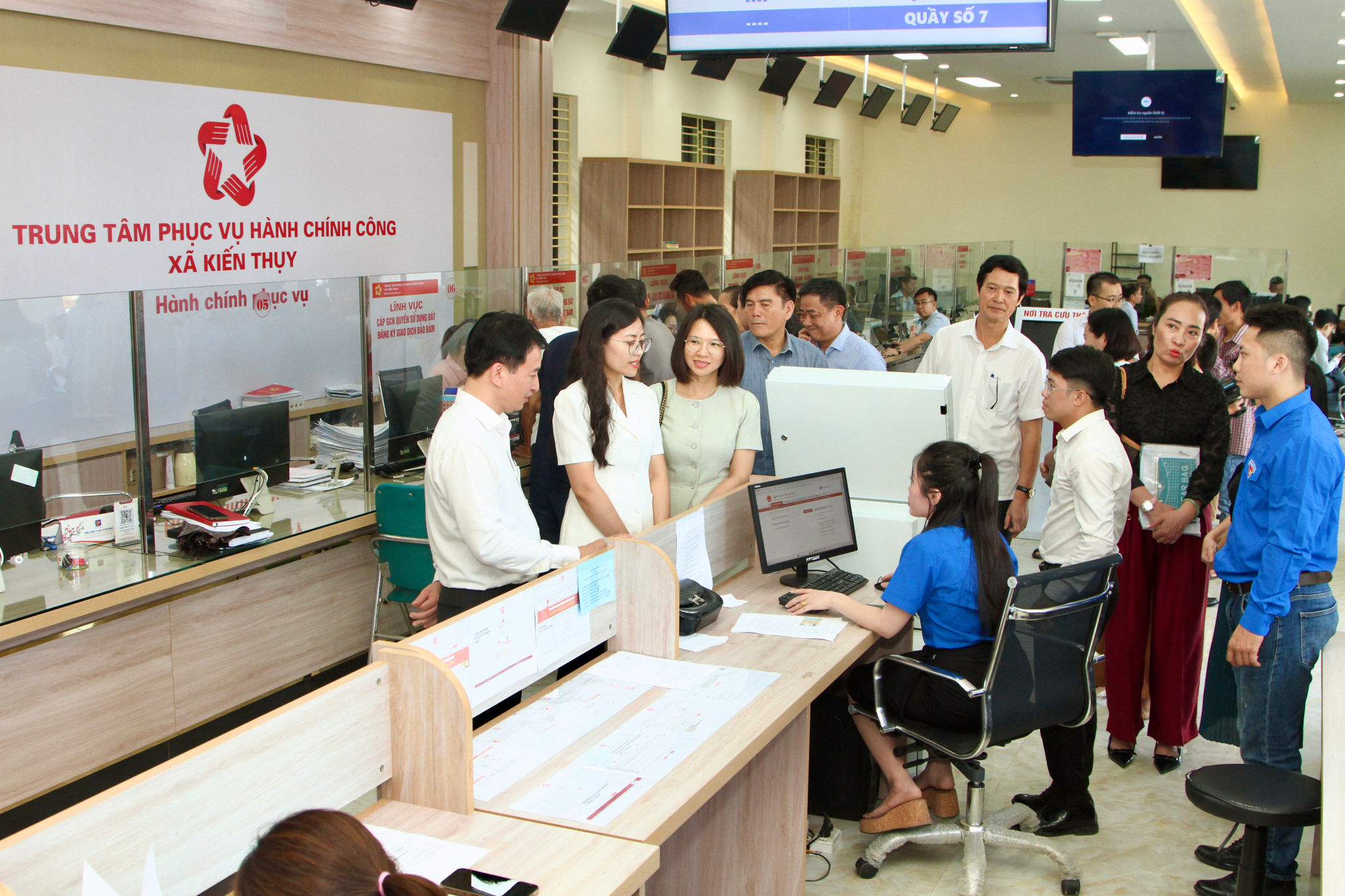
Pursuant to Decree No. 150/2025/ND-CP dated June 12, 2025, of the Government regulating the organization of specialized agencies under the People’s Committees of provinces and centrally-run cities and People’s Committees of communes, wards and special zones under provinces and centrally-run cities, the whole country established 465 specialized agencies under the Provincial People’s Committees, including 12 specialized agencies organized uniformly in 34 provinces and cities; and 56 specialized agencies in a number of localities (Department of Ethnic Minorities and Religions, Department of Foreign Affairs, Department of Tourism, Department of Planning and Architecture, Department of Food Safety); 9,916 specialized departments at the commune level have been established in communes, wards and special zones (some communes and special zones - administrative units at the commune level that are not merged have not yet established enough 03 specialized departments according to the Government’s regulations). Regarding the public administrative service center, based on the provisions of Decree No. 118/2025/ND-CP dated June 9, 2025, of the Government on implementing administrative procedures under the one-stop mechanism, one-stop connection at the one-stop department and the national public service portal, there are currently 32 provinces and cities implementing the two-level model (including the public administrative service center under the provincial People’s Committee office and the public administrative service center under the commune-level People’s Committee); for Hanoi City and Quang Ninh province, implementing the one-level model (the public administrative service center under the provincial People’s Committee, with branches according to inter-commune areas and points for serving procedures and public administrative services at commune-level administrative units).
Based on the provisions of laws, resolutions, decrees, especially 30 decrees of the Government, ministries and branches have reviewed and issued 66 circulars to continue decentralizing, defining authority and guiding the contents under the authority of state management on the organization of two-level local governments; issued circulars guiding the functions, tasks and powers of specialized agencies under the People’s Committees at the provincial and commune levels to promptly resolve difficulties and problems of localities to ensure the operation of two-level local governments is continuous, smooth and uninterrupted.
After more than 01 month of implementation, according to the report of the Ministry of Home Affairs - the standing agency of the Steering Committee for the implementation of the arrangement and reorganization of administrative units at all levels and the development of a two-level local government organization model, in the context of a large workload, tight deadlines, and a broad range of affected entities, the operation of the two-level government has initially achieved many important results, such as:
- Completing the arrangement and consolidation of the People’s Council and People’s Committee at the provincial and communal levels; establishing specialized agencies and administrative organizations; issuing decisions to establish public service units at the provincial and communal levels; arranging cadres and civil servants to hold leadership and management positions to directly manage activities immediately after the two-level local government comes into operation.
- Carrying out procedures for receiving and handling administrative procedures for people and businesses; operating the software system for handling administrative procedures in operations, handling work, and successfully connecting and interconnecting the National Public Service Portal; developing a plan to deploy science and technology development, innovation, and digital transformation.
- Settling regimes and policies for cadres, civil servants, and public employees after the administrative unit reorganization has been given attention and resolved according to regulations. As of July 29, 2025, the number of resignations and retirements according to Decree No. 178/2024/ND-CP (amended and supplemented by Decree No. 67/2025/ND-CP) is 85,634 cadres, civil servants, and public employees. Localities are making lists and conducting appraisal processes to resolve regimes and policies for non-professional commune-level workers who have retired from July 1, 2025.
- Arranging, allocating, and handling headquarters and public assets when rearranging administrative units (according to the report of the Ministry of Finance, as of July 24, 2025, the total number of surplus houses and land facilities that need to continue to be handled is 9,002 facilities at both provincial and commune levels).
- Many localities have issued specific plans to strengthen document and archive management during the process of restructuring the apparatus; properly handing over documents and databases after restructuring, ensuring strictness and safety; digitizing historical archives, administrative documents, and specialized documents, gradually forming an electronic database for management purposes.
- The security, political situation, and social order and safety across the country has been maintained, without major and complicated problems arising. The vast majority of people agree with the policy of rearranging administrative units and streamlining the political system to meet the country’s rapid and sustainable development in the new era.
2.3. Some difficulties and problems in implementing the two-level local government model and their causes
The organizational structure is not yet suitable; the number of specialized departments of the People’s Committee at the commune level is regulated uniformly among the administrative units at the commune level (including the office of the People’s Council and the People’s Committee and 02 specialized departments), while the natural area, population and number of tasks and fields between the communes and wards are very different. Some local authorities at the commune level have not arranged enough key leadership positions at the commune level. The establishment, arrangement, and reorganization of public service units at the commune level in some localities are still problematic; the authority to implement is unclear; regulations on the authority to appoint leaders and manage school units in the communes, wards, and special zones are still inconsistent.
The quantity and quality of staff and civil servants are not evenly distributed among commune-level administrative units; the number and structure of professional civil servants in many commune-level administrative units are both excessive and insufficient. In many communes and special zones, there is a lack of civil servants with professional qualifications in the fields of information technology, land administration, finance, health, construction, transportation, etc. Solving the surplus of staff, civil servants, and public employees after the reorganization of administrative units is a great pressure on localities.
Some cadres and civil servants affected by the reorganization of the apparatus and organization of the two-level local government have not yet been covered by the regimes and policies in Decree No. 178/2025/ND-CP (amended and supplemented by Decree No. 67/2025/ND-CP). Some localities are confused about how to arrange for non-professional workers at the commune level to continue working until May 30, 2026, at the latest, according to the direction of the Central Government. Many localities have difficulty in arranging housing and vehicles for cadres and civil servants when they move to a new location.
The infrastructure system of the public administrative service center at the central, provincial, and communal levels is not yet synchronous and unified, so it is difficult to connect and does not ensure full public services. In many newly merged commune-level administrative units, cadres and civil servants have not been fully granted digital signatures and accounts to log into the management and operation system; the information technology infrastructure is not yet guaranteed, causing interruptions in processing electronic records and documents and providing public services. Specialized equipment (scanners, barcode readers, etc.) to serve work and digitization in many localities has not been fully provided. The digital transformation capacity and scientific and technological level of the communal-level cadres and civil servants are still limited, while the volume of administrative procedures to be resolved at the communal level is very large, and the number of people needed to carry out administrative procedures is increasing.
Working facilities and conditions are still limited. Offices in some localities, especially at the commune level in mountainous areas, are still lacking or degraded, cramped, insufficient in area, and scattered. The functions of the current office are only sufficient to accommodate agencies, organizations, and units before the rearrangement, leading to the arrangement of the office not being concentrated, causing difficulties in direction and operation. Some centers and points for performing administrative procedures are far away, and do not ensure convenient travel for people when handling procedures. Handling redundant offices according to the plan to convert the functions into medical facilities, education, and public works in some localities is difficult due to the lack of guidance or lack of suitability.
The assignment, decentralization of management, and organization of public service provision in urban areas are still inadequate. The Law on Organization of Local Government stipulates that “a ward is an administrative unit in urban areas”, that is, only one locality (area) of urban areas, while in reality, urban areas are a unified and interconnected entity in terms of infrastructure. Therefore, the management and organization of public service provision, especially public services such as lighting, water supply, drainage, waste collection, environmental sanitation, parks, and trees in urban areas, are still confusing and problematic.
The reason for the above limitations and difficulties is that the two-level government organization model is an institutional reform, which has a profound impact on the political system in general, the local government in particular, and the lives of staff, civil servants, and the people. However, the time for preparation and official operation is relatively short, while the workload is large, the implementation area is wide, the ministries and branches implement in the spirit of “running while queuing”; the formulation of laws, decrees and circulars guiding the implementation of two-level local government must meet urgent progress requirements; relevant agencies and drafting agencies have not anticipated all the problems arising in practice, so the provisions of legal documents are still contradictory, inconsistent, overlapping or in some cases, they are not specific and clear enough for localities to organize implementation.
The capacity, qualifications, and adaptability of the staff, civil servants, and public employees are not uniform. Many staff and civil servants at the grassroots level have not been fully trained and instructed on the new operating model, especially skills related to handling work in the digital environment and electronic administration. A number of staff and civil servants are still afraid of change and confused in handling situations arising after the reorganization of the apparatus.
Technical and human resources conditions for digital transformation have not been fully prepared. Physical facilities, technical infrastructure, and information technology are still limited, especially in remote communes, remote areas, and disadvantaged localities. Information technology infrastructure has not been synchronously invested in; management and operation software is not yet connected smoothly with the provincial level; network transmission is weak, and there is a lack of computers, printers, storage devices, etc. The implementation of digitization tasks, data interconnection, digital signature, and electronic record processing still faces many objective obstacles due to a lack of ensuring conditions.
In addition, the leadership and direction in some localities have not been truly drastic and synchronous; the direction of the Central Government, the Government, and the Prime Minister has not been timely concretized into specific programs and action plans; some places are still confused in the implementation stage, leading to slow progress and quality that does not meet the requirements.
2.4. Some solutions to continue perfecting the two-level local government model
Thoroughly grasp and fully implement the contents of Conclusion No. 179-KL/TW dated July 25, 2025, of the Politburo and the Secretariat on continuing to deploy tasks of perfecting the organization and operation of the two-level local government model. Accordingly, it is necessary to focus on implementing the following solutions:
Firstly, strengthen communication work on the necessity and superiority of implementing the two-level local government model in our country in the new context, disseminate information on the activities of two-level local governments; arouse patriotism, aspiration to contribute, determination among cadres and civil servants; raise awareness, strengthen trust, and create consensus in the whole society.
Secondly, ministries, branches, Party committees, local authorities, especially leaders, must focus on leadership and closely direction, firmly grasping the situation at the grassroots level, promptly guide, remove and resolve difficulties and problems arising in the areas under their responsibility, especially in handling procedures for people and businesses on land, construction permits, investment procedures, taxes, business...; pay attention to arranging sufficient staff at commune-level public administrative service centers. Regularly check the implementation of regulations on decentralization, delegation of authority, and division of authority; on work processes, records, administrative procedures...; on providing public services as well as online public services.
Thirdly, relevant agencies and organizations should continue to review and promulgate laws, resolutions, decrees, and circulars related to decentralization, delegation of power, and division of authority; review and adjust specialized legal documents that have overlapping, inappropriate, or are lacking specific provisions, ensuring clear distinction between the provincial and communal levels, avoiding duplication and omission of management functions in order to remove difficulties, obstacles, and legal bottlenecks in accordance with the direction of the Politburo... Issue guidelines on procedures and standards for implementing tasks and powers decentralized to the provincial and communal levels; fully announce and publicize administrative procedures to the people and businesses. Provincial People’s Committees should urgently promulgate regulations on functions, tasks, and organizational structures of specialized agencies at the provincial and communal levels, ensuring clarity of persons and tasks, with no overlapping, omission of functions and tasks; Strongly shift the grassroots level towards proactively grasping and managing the socio-economy, national defense, and security.
Fourthly, the Government directs relevant ministries and branches to coordinate with local authorities to complete technology infrastructure and database infrastructure to ensure quality, serving the activities and operations of commune-level public administrative service centers; ensuring the completion of “eliminating wave depressions” so that villages and hamlets have conditions to access digital transformation; urgently and synchronously implement the database on justice and civil status; and fix errors in the public service software system and civil status software to facilitate the handling of administrative procedures for the people.
Fifthly, ministries and ministerial-level agencies should strengthen the activities of working groups and inter-sectoral support groups and assign civil servants to act as permanent focal points to receive, guide, and provide technical support and closely monitor the progress of implementing the two-level local government model in localities, especially at the commune level; proactively guide localities to remove difficulties and handle problems related to apparatus organization, the transfer of cadres and civil servants, decentralization of tasks, budget allocation, use of facilities, connection of information technology infrastructure, population data and household registration.
Sixthly, review, evaluate, and classify in conjunction with restructuring and improving the quality of the staff and civil servants at the commune level after the reorganization, so that those who do not meet the requirements of the tasks as assigned can be dismissed according to the regime, and at the same time, supplement new forces. Organize professional and technical training; foster and update knowledge and information regularly and continuously, prioritizing timely implementation during the operation phase of the new apparatus in order of importance and necessity, such as tax, business registration, land, information technology, environment, health, and so on.
Seventhly, to ensure the requirements of unified and effective management of urban infrastructure and provision of public services to organizations and citizens, it is necessary to regulate the relationship between ward authorities in organizing and providing public services regardless of administrative boundaries. It is possible to refer to the experience of organizing inter-ward and commune councils (soft, voluntary organizations - not of state administrative nature) of countries around the world in order to expand development space and effectively solve socio-economic problems of inter-administrative unit nature, especially in urban areas.
3. Conclusion
The merging of provincial administrative units and the implementation of the two-level local government organization model is not purely a reform of the apparatus, reducing intermediate levels, but a strategic decision of historical significance, demonstrating the strong administrative reform thinking of the Party and State, aiming to build a modern, streamlined, strong, close-to-the-people, better-serving local government, in line with the development trend of the country and the development of modern administration in the world, as well. Although there is still much work to be done, the recent achievements have affirmed the correctness of the policy of building a two-level local government model, and at the same time demonstrated the great efforts of all levels, sectors, and the support of the people.
_________________
Received: August 4, 2025; Revised: August 25, 2025; Approved for publication: August 28, 2025.
Author’s e-mail: nmphuongdhnv@gmail.com
Endnotes:
1. National Assembly: Resolution No. 203/2025/QH15 on amending and supplementing a number of articles of the 2013 Constitution.
2. National Assembly: Law on Organization of Local Government No. 72/2025/QH15.
3. Conclusion No. 179-KL/TW dated July 25, 2025, of the Politburo and the Secretariat on continuing to implement tasks of perfecting the organization and operation of the two-level local government model.
4. Ministry of Home Affairs: Draft report summarizing the situation of 01 month of implementation and operation of the two-level local government model.
Under supervisory of: Ho Chi Minh National Academy of Politics
Editor in Chief: Assoc. Prof., Dr. Nguyen Thang Loi