Gửi bình luận
Hủy
Gửi
Mon, 19/10/2026

DOI: https://doi.org/10.70786/PTOJ.2026.6671
Abstract: The Great Victory of Spring 1975 was the great victory of the Vietnamese people in the 20th century. It was the victory of the aspiration for peace, independence, freedom, and national reunification; it was the pinnacle of the crystallization of the patriotic tradition and the strength of great national unity in the Ho Chi Minh era; and a significant contribution to the global people’s struggle for peace, national independence, democracy, and social progress. Half a century has passed, but the spirit of the Great Victory of Spring 1975 remains a driving force for our entire Party, people and military to uphold the patriotic tradition, the strength of great national unity, comprehensively and synchronously promote the renovation process to realize the aspiration of building a prosperous, civilized and happy Vietnam.
Assoc.Prof., Dr. NGUYEN DANH TIEN
Head of the Institute of Party History,
Ho Chi Minh National Academy of Politics
1. Introduction
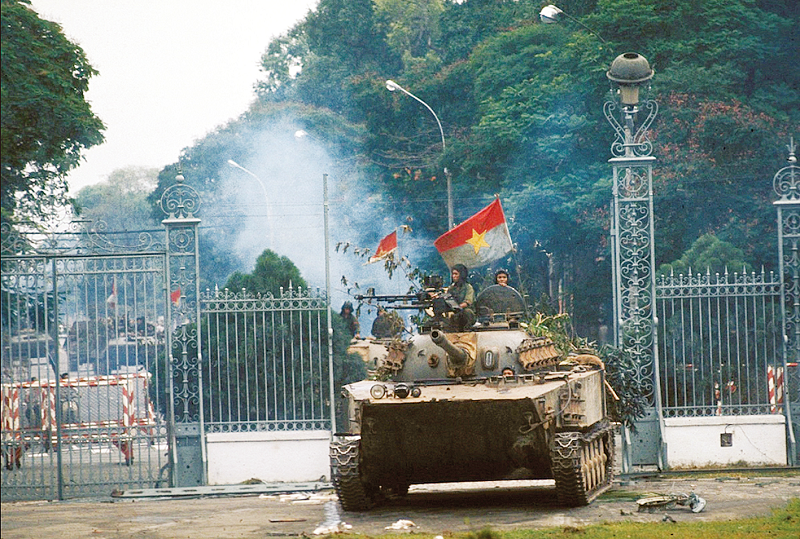
The General Offensive and Uprising in the Spring of 1975, culminating in the historic Ho Chi Minh Campaign, successfully concluded our nation’s heroic resistance war against the US, liberated the South, reunified the country, and led the whole country to socialism. That great victory was the result of the arduous and sacrificial struggles of generations of Vietnamese people, who inherited and raised to a new height the tradition of patriotism, the strength of the cultural strength of the Vietnamese people; and at the same time, it was the crystallization of the aspiration for independence, freedom and national unification of the entire nation. The great victory of Spring 1975 created the premise and motivation to realize the aspiration to build a rich, civilized, and happy country.
2. Content
2.1. The Great Victory of Spring 1975 was the victory of the aspiration for peace, independence, freedom and national reunification
Immediately after the 1954 Geneva Agreement on Indochina was signed, the US replaced France and established the Ngo Dinh Diem government in the South, implementing a plot to divide the country of Vietnam, turning South Vietnam into a new type of colony and a US military base in Indochina and Southeast Asia. To carry out this plot, the US imperialists increased their support for Ngo Dinh Diem to sabotage the Geneva Agreement, eliminate pro-French forces, and seize power to rule the South; focused on destroying revolutionary bases and terrorizing the people. That situation reflected the reality that “ US imperialism is the obstacle preventing the restoration of peace in Indochina” and “is becoming the direct main enemy of the people of Indochina”(1).
Facing that situation, with the sacred mission of liberating the South and reunifying the country, and with the determination: “Our Vietnam must be unified. The people of the South and the North will definitely reunite as one family”(2), while at the same time, imbued with the truth: “The South is the blood of the Vietnamese blood, the flesh of the flesh of Vietnam. Rivers may dry up, mountains may erode, but this truth will never change”(3), the Vietnamese people once again rose up to drive out the American imperialists and their lackeys. “Nothing is more precious than independence and freedom” - the truth that President Ho Chi Minh proclaimed became the way of life and the guiding principle for action for generations of Vietnamese people. Thanks to that, the patriotic spirit of millions as one was awakened and promoted, ready to fight and sacrifice for the independence and freedom of the Fatherland, for the happiness of the people.
During the resistance war against the US for national salvation, the desire for peace, independence, freedom, and national reunification grew ever stronger among generations of patriotic Vietnamese people, generating courage, bravery, and intelligence, and becoming the bond uniting the entire Party, army, and people in solidarity and unanimity, with the spirit of “Splitting the Truong Son Range to salvage the country”, “All for the front line, all to defeat the American invaders”, “All for the cause of liberating the South and reunifying the country”; and then, that desire was fanned into a true revolutionary flame “fighting to drive the US out”, “fighting to overthrow the puppet regime”, advancing to Saigon, liberating the South, and unifying the country.
On this matter, historian Stanley Karnow wrote in his book Vietnam: A History, summarizing the misjudgment of successive U.S. presidents: it stemmed from their ignorance of Vietnamese history - a long and painful history of wars, conflicts, and adjustments that had forged a profound sense of national consciousness among the Vietnamese people. In the book Looking Back - The tragedy and lessons of Vietnam by former US Secretary of Defense R. McNamara published in April 1995, he acknowledged 11 reasons for the US failure in the war of aggression against Vietnam, in which the third reason was that the US “underestimated the power of nationalism that motivates a nation (in this case, North Vietnam and the Viet Cong) to fight and sacrifice for their ideals and values”(4).
The victory of Spring General Offensive and Uprising in the Spring of 1975 was the victory of Vietnamese courage and intelligence. It was a brilliant feat, a great victory of our armed forces and people under the leadership of the Party; it affirmed the extraordinary willpower of our people, and at the same time affirmed the strong will and determination to liberate the South and reunify the country in the Ho Chi Minh era. That victory was the result of 30 years of struggle for national liberation and reunification; it was the victory of the aspiration for peace, independence, freedom, and national reunification, opening a new era in the history of the nation - the era of: Peace, independence, reunification, and national advancement towards socialism.
2.2. The Great Victory of Spring 1975 was the pinnacle of the crystallization of patriotic tradition and the strength of great national unity in the Ho Chi Minh era
Upholding the patriotic tradition of the nation, throughout historical periods, especially during the resistance war against the United States for national salvation, our Party and President Ho Chi Minh aroused “the fervent patriotism and extraordinary revolutionary heroism of compatriots, soldiers, cadres, and Party members of all fraternal ethnicities from South to North who united and fought tirelessly for the cause of national liberation and reunification of the Fatherland”(5).
In the South, despite having to endure savage and brutal repression from the enemy, with their indomitable will, the people still wholeheartedly remained loyal to the revolution, had absolute faith in the leadership of the Party and the cause of national reunification. They fought bravely, gradually defeating the strategies of “special war”, “localized war”, and “Vietnamization of the war”, thereby laying the groundwork to move forward towards total victory.
In the North, implementing the slogans: “one hand plows, one hand fights”, “one hand wields the hammer, one hand wields the gun”, “not a pound of rice short, not a soldier lacking” and with the spirit of “Splitting the Truong Son range to salvage the country”, all classes of people both built socialism and fought to protect the North, while supporting the front line in the South. Overseas Vietnamese looked toward the Fatherland, contributing material and effort, together with progressive and peace-loving peoples, opening a front of struggle worldwide and even within the enemy’s ranks, making worthy contributions to the day of the nation’s total victory(6).
Among the factors contributing to the Great Victory of Spring 1975, the tradition of patriotism and the strength of the great national unity bloc were particularly important values, something that the Americans themselves acknowledged: “The national spirit and pride ignited in the heart of every Vietnamese, sparking a determination to drive out the foreign invaders. That national spirit, pride and determination developed into the greatest power - a will of steel - helping them accomplish what seemed impossible. In the end, the will of steel defeated the most powerful superpower’s technology in the world”(7).
Our Party inspired and brought into full play the strength of the great national unity bloc, creating immense power with the spirit: “Solidarity, solidarity, great solidarity, / Success, success, great success”. That is the unity and solidarity within the Party, national solidarity, unity of the entire people, solidarity between the South and the North and close solidarity between the armed forces and all classes of people; and international solidarity.
Entering the resistance war against the US for national salvation in the circumstance where the country was temporarily divided into two regions, under the leadership of the Party, our people carried out two different revolutionary strategies, facing many difficulties and challenges. However, with solidarity, unity of will and action, the Party brought into full play the combined strength of the whole country. In the Great Victory of Spring 1975, with the spirit of “one day equals twenty years”, the forces participating in the campaign mobilized an unprecedented number of troops, along with a huge amount of supplies. From 1973 to 1975 alone, the North sent to the battlefield 57,000 tons of ammunition and 154,217 tons of other supplies(8).
The great victory of Spring 1975 was the result of the convergence of the strength of the army and people of the whole country, the strength of the great national unity bloc. It was the strength of the Vietnamese people’s resistance war, with the great sacrifices of compatriots and soldiers in the South on the major front line and the wholehearted support of the great rear in the North. Referring to the strength of the great national unity bloc, when answering interviews with Western journalists and scholars, General Van Tien Dung emphasized: “Once again, I want to make it clear that the origin of all our victories is the strength of an entire nation rising up to master the country, master its own destiny in today’s era. And our leadership knows how to harness and promote all those strengths to achieve victory”(9).
2.3. The Great Victory of Spring 1975 contributed significantly to the struggle of the global people’s struggle for peace, national independence, democracy and social progress
During the process of waging its war of aggression against Vietnam, U.S. imperialism carried out the scheme of “swallowing up South Vietnam, turning it into a neo-colony, into a military base and a defensive line to prevent the spread of socialism into Southeast Asia, using the South as a springboard to attack the North, as the first place to apply US global military strategies, test military tactics, technical inventions, and modern weapons”(10).
Faced that insidious scheme, the peace-loving and progressive forces around the world were constantly raising the question: Could Vietnam withstand U.S. imperialism? And would the “spark” of Vietnam be contained or would it ignite into a world war? At that time, all humanity was anxious and closely following the escalating military situation in Vietnam day by day. Therefore, “regarding the Vietnam issue, some countries, while denouncing and opposing the aggressive acts of U.S. imperialism and supporting the just resistance of the Vietnamese people, also expressed concern that Vietnam might be crushed by U.S. military power, and advised Vietnam to exercise self-restraint”(11).
In reality, the Vietnamese people’s resistance war against the US to salvage the country was a just cause and thus received sympathy, support, and assistance from the majority of progressive, peace-loving people, especially from socialist countries. Therefore, “our victory is the victory of the socialist, national independence, democratic and peace forces throughout the world that supported our people in the struggle against the invading US imperialists”(12).
The victory of the 1975 Spring General Offensive and Uprising, culminating in the historic Ho Chi Minh Campaign, affirmed a truth, a rare phenomenon in the history of modern world war: “... in today’s era, no matter how small a nation is, no matter how small its territory is, how small its population is and how underdeveloped its economy is, if it is united and determined, if it has a correct revolutionary guideline, if it knows how to creatively apply the principles of socialism to its specific conditions and with the help of the socialist camp, of progressive humanity, it can completely defeat invaders many times stronger, including the ringleader of imperialism, US imperialists”(13).
The great victory of the Vietnamese people in the Spring of 1975 was of great epochal significance, because it directly and significantly contributed to the struggle of the people around the world for peace, national independence, democracy and social progress. President of the Democratic People’s Republic of Korea Kim Il Sung affirmed: “The great victory of the Spring of 1975 was a common victory of all revolutionary peoples in the world, making an important contribution to the struggle against imperialism and national liberation of oppressed peoples”(14). General Secretary of the Communist Party of China Mao Zedong emphasized: “The victory of comrades has strongly encouraged all oppressed peoples and nations who are struggling, setting a shining example for the revolutionary cause against US imperialism by the people all across the world”(15).
2.4. The Great Victory of Spring 1975 laid the foundation and created the motivation to realize the aspiration of building a rich, civilized, prosperous, and happy country
After the victory of the resistance war against the US for national salvation, the country was reunited, and the entire country advanced toward building socialism amidst countless difficulties and challenges. Under the leadership of the Party, our military and people focused on overcoming the consequences of war, developing the country’s economy, culture and society, while defending the Fatherland along the southwestern and northern borders and assisting the Cambodian people in escaping genocide; at the same time, taking gradual steps to innovate in agriculture, industry, and initial theoretical thinking about socialism. However, due to the prolonged maintenance of the centralized, bureaucratic, subsidized mechanism; and due to subjective, voluntarist tendencies in planning and organizing the implementation of the socialist revolutionary line, which at times and in places even committing errors and shortcomings, there arose stagnation and a severe socio-economic crisis.
With the spirit of “looking straight at the truth”, “correctly assessing the truth”, “speaking the truth clearly”, the 6th National Party Congress (December 1986) set out a comprehensive renovation policy for the country, marking an important milestone on the journey to socialism in Vietnam. After the 6th Congress, the theory of socialism and the renovation policy were gradually supplemented and developed in accordance with the country’s material conditions. It is worth noting that, in the face of severe challenges caused by the collapse of the socialist regime in the Soviet Union and Eastern Europe (late 80s, early 90s of the 20th century), the Party still affirmed: “Socialism is currently facing many difficulties and challenges, and world history is going through twists and turns; however, humanity will ultimately advance towards socialism because that is the evolutionary law of history”(16).
Steadfastly following the path to socialism in accordance with the specific conditions and characteristics of Vietnam, the Platform for national construction in the transitional period to socialism (1991 Platform) and the Platform (supplemented and developed in 2011) identified the basic characteristics of a socialist society, contributing to orienting the development path of the Vietnamese revolution in the new period.
The Party has set forth the policy of rapid and sustainable development of the country along the path to socialism; promoting the cause of industrialization, modernization of the country and international integration; implementing three strategic breakthroughs: renovating development institutions, especially the socialist-oriented market economic institution; developing human resources, focusing on high-quality human resources; building synchronous infrastructure; at the same time, promoting economic restructuring associated with growth model renovation; consistently implementing four steadfast views: steadfastness in the Party’s ideological foundation (Marxism-Leninism and Ho Chi Minh Thought), steadfastness in the goal of national independence and socialism, steadfastness in the path of renovation, and steadfastness in the principles of Party building; resolving major relationships in the process of building and developing the country according to the motto: economic development is the central task, Party building is the key task, cultural development is the spiritual foundation of society; national defense and security are important and regular tasks.
Implementing the Party’s guidelines, the National Assembly institutionalized it by promulgating the 1992 Constitution and the 2013 Constitution, along with the legal system that has increasingly become synchronous and a suitable legal basis for the process of renovation, industrialization, modernization and international integration. The Government has concretized into mechanisms, policies and specific solutions to manage and govern the construction, development of the country and defense of the Fatherland in the new period.
Thanks to the Party’s wise leadership, after nearly 40 years of renovation, with unity and consensus, with the will and aspiration to rise and “stand shoulder to shoulder with the great powers of the five continents” as President Ho Chi Minh’s wish and the aspiration of the entire nation; with the determination to build a Vietnam with a rich people, strong country, democracy, justice, civilization, prosperity, and happiness, “From a poor, backward, low-level, besieged and embargoed country, Vietnam has become a developing country, with average income, deeply and widely integrated into the world politics, the global economy, and human civilization”(17).
Political, economic, cultural, social, scientific - technological, national defense and security potential has constantly been enhanced. By 2024, Vietnam’s economic growth reached 7.09%; the economic scale reached about USD470 billion, ranking 33rd; the national brand value reached USD 507 billion, ranking 32nd/193 countries; exports reached about USD 405 billion; foreign direct investment attracted over USD 31 billion(18). The global renovation index ranked 44/132 countries and territories. The multidimensional poverty rate decreased to about 1.9%. The happiness index increased by 11 places, ranking 54/143(19). The sustainable development index (SDGs) ranked 54/166 countries and territories(20).
National independence, sovereignty, political security and social order and safety have always been firmly maintained. Foreign affairs and international integration continue to be promoted. Vietnam’s prestige and position in the international arena are constantly rising. Vietnam continues to be a safe and attractive destination for businesses, partners, investors, tourists, and international friends. That is the result of the extraordinary will, determination and innovative thinking of the Vietnamese people under the leadership of the Party, affirming that the socialism and the path to socialism in Vietnam are correct, consistent with objective laws and development trends of the times. Among all factors, the correct leadership of the Party is the foremost determinant of every victory of the Vietnamese revolution.
3. Conclusion
The victory of the General Offensive and Uprising in the Spring of 1975, culminating in the historic Ho Chi Minh Campaign, was a shining milestone, a glorious chapter in the history of nation-building and national defense of the Vietnamese people under the leadership of the Party and President Ho Chi Minh, opening a new era - the era of independence, reunification, with the whole country advancing towards socialism. 50 years have passed, but the heroic spirit of the Great Spring Victory of 1975 remains a spiritual driving force for the entire Party, people, and armed forces to bring into full play the patriotic tradition and the strength of the great national unity bloc, and to comprehensively and synchronously promote the renovation process. After 50 years of national reunification, especially after nearly 40 years of advancing the renovation process, our country has gained many achievements of historical significance. That is the basis and foundation for our entire Party, people, and armed forces to enter a new era of development, building a strong, prosperous, happy and civilized Vietnam.
_________________
Received: April 9, 2025; Revised: April 19, 2025; Approved for publication: April 24, 2025.
Author e-mail: ngdanhtien@gmail.com
Endnotes:
(1) Communist Party of Vietnam: Complete Party Documents, vol. 15, National Political Publishing House, Hanoi, 2001, p. 225.
(2) Ho Chi Minh: Complete Works, vol.10, National Political Publishing House, Hanoi, 2011, pp.359-360.
(3) Keeping His Sleep Peaceful, People’s Army Publishing House, Hanoi, 2005, p.18.
(4) R. McNamara: Looking Back at the Past - The Tragedy and Lessons of Vietnam, National Political Publishing House, Hanoi, 1995, p.316.
(5), (12) Communist Party of Vietnam: Complete Party Documents, vol.37, National Political Publishing House, Hanoi, 2004, p.981, 983.
(6) Vietnam Historical Science Association: Vietnam People’s War - Period 1954-1975 (Some topics), Social Sciences Publishing House, Hanoi, 2021, pp.158-159.
(7) Bare Foot, Steel Will, Ho Chi Minh City General Publishing House, 2011, p.8.
(8) Nguyen Xuan Tu: The Northern Front in the Resistance War Against the US, Salvaging the Country (1954 - 1975), National Political Publishing House, Hanoi, 2009, p.215.
(9) Pham Van Dong, Le Duc Tho, Van Tien Dung, Nguyen Co Thach: Why the US Failed in the War of Aggression against Vietnam, Truth Publishing House, Hanoi, 1986, p.48.
(10), (11) The Great Victory of Spring 1975 - Vietnamese Courage and Wisdom, People’s Army Publishing House, Hanoi, 2006, pp.915, 916.
(13) The Heroic Struggle Related to the Third World: What is Vietnam’s Relationship to Us? Supplement of Peru’s “Fast News” Newspaper, Issue 4-5-1975.
(14), (15) The South - 21 years of resistance against the US - Records on the resistance of the army and people of the South, Political - Administrative Publishing House, Hanoi, 2012, pp.10, 8.
(16) Communist Party of Vietnam: Platform for national construction in the transitional period to socialism, Truth Publishing House, Hanoi, 1991, p.8.
(17) See: Article by General Secretary Nguyen Phu Trong commemorating the 94th anniversary of the Party’s founding, published in Nhan Dan Newspaper, February 1, 2024.
(18) See: General Statistics Office 2024.
(19) See: Report on the United Nations Sustainable Development Solutions Network.
(20) See: United Nations Report.

Under supervisory of: Ho Chi Minh National Academy of Politics
Editor in Chief: Assoc. Prof., Dr. Nguyen Thang Loi