

Ho Chi Minh National Academy of Politics: 75 years of solid progress and development
DOI: https://doi.org/10.70786/PTOJ.2026.7099
Abstract: In 1949, during a new phase in the Vietnamese people's resistance war and nation-building efforts, the enhancement of political theoretical education for the cadre force, especially high-ranking officials, became extremely necessary. In this context, at the 4th Conference of the Central Executive Committee (1st tenure) in January 1949, the Party decided to establish a system of Party schools at various levels, marking the founding of the Nguyen Ai Quoc Party School, the predecessor of today's Ho Chi Minh National Academy of Politics.
DR. LE MINH NGOC
MA. TA PHUONG LIEN
Political Theory Journal,
Ho Chi Minh National Academy of Politics
1. Introduction
Through the stages of construction and development (1949-2024), the Ho Chi Minh National Academy of Politics has made important contributions to training mid- and high-level cadres for the Party and the political system from the central to local levels, helping to equip them with political theoretical knowledge, practical organizational capacity, and the necessary qualities to effectively meet the strategic goals and tasks of the revolution in each historical period. The Academy plays an important role in researching, propagating and educating Marxism-Leninism and Ho Chi Minh Thought, affirming its position as a national center for political theoretical research and policy consultancy for the Party and the State.
In recognition of the great contributions by the Central Party School (now the Ho Chi Minh National Academy of Politics), the Party and the State have awarded the Academy many notable awards and titles: twice the Ho Chi Minh Medal, the Gold Star Medal, the title of Labor Hero in the renovation period, and many other prestigious titles. These represent the acknowledgment and appreciation of the Party, State, and people for the significant achievements and worthy contributions of the Academy to the revolutionary cause of the Party and the nation.
To attain these achievements, there has been the close leadership and direction of the Party Committee of the Academy during each stage of the Academy’s development, contributing to the successful implementation of the tasks set out in each specific period. The history of the Academy’s Party Committee is reflected through the heroic historical pages of the Academy, closely linked to the history of the resistance war, national construction, and the building of the country’s socialist regime.
2. Ho Chi Minh National Academy of Politics - The stages of construction and development
Early years of establishment: The Nguyen Ai Quoc Party School overcame difficulties, contributed to the resistance war against French colonialism, and fought for national reunification (1949-1975)
In January 1949, the sixth Central Cadre Conference was held in the Viet Bac resistance zone as the war against French colonialism entered a new stage. In that context, the Conference stated, “The lack of theoretical knowledge and culture makes cadres progress slowly (...) Therefore, organizing study within the Party to give cadres a solid political foundation to be able to understand and follow the Party’s guidelines in difficult times becomes more urgent”(1). Thereby, the Conference proposed the guideline: “Raising the political and theoretical level of Party members. All Party members must master the Party’s line and policies: study ideology, military strategy and tactics, and basic knowledge of government work. Wherever new Party members are organized, training must be conducted there (...) Party schools must open continuously, with clear divisions of responsibility among central, regional, and provincial schools”(2). This was a turning point conference, marking the birth of the Nguyen Ai Quoc Party School, the predecessor of today’s Ho Chi Minh National Academy of Politics.
Nguyen Ai Quoc Party School was established and operated in the Viet Bac resistance base under the challenging conditions of arduous war, under the direct charge of Comrade Truong Chinh, General Secretary of the Party. With the defined role as a school for training political theory for high-ranking cadres, from the earliest classes to later ones, many Party leaders and senior officials directly gave lectures, participated in discussions, and answered students’ questions about the Party’s lines. Especially, President Ho Chi Minh paid great attention to cadre training at the school. He visited and worked with the school many times and provided valuable guidance, which became the guiding principle throughout the school’s activities and the Party’s cadre training work.
Regarding the Party organization, from 1960, the Nguyen Ai Quoc Party School established Party organizations with two main systems, each system playing an important role and fulfilling certain tasks to ensure the effective leadership and management of the school. The school’s Party Committee was initially under the Central Party Committee for Civil Affairs and was primarily responsible for directing the school’s internal activities, ensuring that political and educational tasks were carried out in accordance with the Party’s guidelines and policies. After a period of time, this Party Committee was transferred to the Hanoi Party Committee, expanding its scope of activities and more closely connecting with city-level Party agencies. This change not only helped strengthen the coordination between the school and local Party agencies but also created favorable conditions for the school’s Party Committee to contribute more to the country’s political and social activities.
In addition to the school’s Party Committee, the class-level student Party cells played an important role in the Party organization system at Nguyen Ai Quoc Party School. These cells were assigned by the Secretariat to the school’s Board of Directors to act as the Party work supervisors. The Board of Directors not only managed administrative and academic affairs but also directly led Party activities among student classes. This system of Party cells helped connect students with Party activities, creating a favorable environment for students to discuss, exchange, and deepen their understanding of theoretical and practical Party work.
The division of the Party organization at the School from 1960 shows the importance of combining political leadership and educational management in cadre training. The construction of a closely-knit party organization system with a clear division of labor helped the school not only fulfill its educational and training tasks but also make important contributions to the revolutionary cause of the Party and the country during various historical periods.
The Nguyen Ai Quoc Party School expands its scale and strengthens its organization to meet the requirements of the early stage of the country’s transition to socialism (1975-1986)
After the liberation of the South and the reunification of the country, the whole country entered a period of building socialism with new requirements and tasks. Accordingly, the leaders of the Party and the State also needed to meet the requirements of the new situation and had to equip themselves with the theoretical understanding and awareness appropriate to the leadership duties of the revolution during this stage. In response to this requirement, on December 22, 1975, the Central Executive Committee of the Vietnam Workers’ Party issued Decision No. 2524/QD-TW on expanding the scale of Nguyen Ai Quoc School. Accordingly, the Nguyen Ai Quoc Party School was expanded in terms of scale, class system, and training program.
Entering the new stage of the revolution, the need for training and fostering cadres became increasingly urgent. To meet this requirement and strengthen training activities in the southern provinces, in July 1977, the Secretariat issued a decision to change the school’s name to the Nguyen Ai Quoc High-Level Party School. At the end of 1980, the Secretariat issued Decision No. 82-QD/TW, aiming to merge the Party Committee of the Nguyen Ai Quoc High-Level Party School with the Party cells and Party Committees of the student classes, thereby forming a unified Party Committee named the Nguyen Ai Quoc High-Level Party Committee, directly under the Hanoi Party Committee.
By mid-1981, the School’s Party Committee was upgraded to a grassroots Party Committee, directly under the Central Executive Committee. This was an important step forward, not only helping to strengthen the Party Committee’s authority and responsibility in comprehensively leading the school’s activities but also demonstrating the Central Committee’s recognition of the role and contribution of the Nguyen Ai Quoc High-Level Party School Party Committee in the work of training cadres.
On November 8, 1982, the Secretariat issued Decision No. 12-QD/TW, transferring the Nguyen Ai Quoc High-Level Party School Party Committee to work under the Party Committee of the Central Agencies in terms of ideological work. The change was an important decision to strengthen the Party’s leadership in ideological and theoretical work. Right after that, in December 1982, the first Congress of the Nguyen Ai Quoc High-Level Party School Party Committee was organized, marking an important milestone in the development of the school’s Party Committee.
To meet the development requirements, the School’s Party Committee was expanded to include 6 student Party Committees, 34 student Party cells, and 25 party cells of affiliated agencies. The role of the Party Committee in orienting, leading, and politically educating party members, especially students, became increasingly important.
On October 15, 1986, the Nguyen Ai Quoc High-Level Party School issued a Decision to establish specialized committees under the School’s Party Committee, including the Organization Committee, the Propaganda Committee, the Science - Education Committee, the Inspection Committee, and the Living Affairs Committee. This Decision not only aimed to improve the Party organization in the School but also helped improve the effectiveness of the Party Committee and the Board of Directors. These specialized committees played an important role in improving the relationship between the Party organization and professional leaders. The active operations of the committees also contributed to improving the quality of Party work, maintaining regular Party cell activities, promoting the spirit of self-criticism and criticism, and strengthening the spirit of solidarity throughout the School.
Throughout the period from 1975 to 1986, under the unified leadership of the Executive Committee of the Party and the School’s Board of Directors, Party work in the various departmental Party committees and Party cells - both student-based and agency-based - was organized more systematically. The educational and combative nature of Party activities was enhanced, contributing positively to the school’s overall operations. These efforts helped the Nguyen Ai Quoc Advanced Party School not only fulfill its role in cadre training but also contribute significantly to the revolutionary cause of the Party and the nation during the country’s transition to socialism.
The Academy’s Party Committee leads cadre training and development in the early period of renovation (1986-1993)
From 1986 to 1993, the renovation policy set out by the 6th National Party Congress gradually came into practice and continued to be consolidated and developed at the 7th National Party Congress (1991). This was a historical period marked by significant turning points, and at the same time, the international situation witnessed complex changes. The socialist countries in Eastern Europe and the Soviet Union collapsed after a long period of crisis. These changes had a profound impact on the thinking of the people, including cadres, party members, lecturers and students of the Academy. These shifts posed new challenges, requiring the Academy to enhance its capabilities in training and developing cadres, scientific research, and international cooperation to meet the demands of the new era.
Training at the Academy received particular attention from the Party Committee and the Board of Directors. The Standing Committee of the Academy’s Party Committee played an important role in directing professional activities, contributing to the development of programs and action plans, and conducting inspections to detect and resolve problems arising in the process of research, lecturing and learning.
At the same time, implementing the directions from the Party Committee and the Board of Directors, the Academy’s Scientific Council promoted the renovation in education and training, especially in student selection. Ensuring standards and procedures for selecting students for all classes was emphasized as a crucial step to improve the quality and effectiveness of training at the Academy.
Regarding Party building work, during the 1986-1988 term, the Academy’s Party Committee carried out important reforms, establishing additional affiliated committees to meet increasingly high work requirements. In addition to the three existing committees, namely the Organization Committee, the Propaganda Committee, and the Inspection Committee, the Academy’s Party Committee established the Science and Education Committee, responsible for monitoring, inspecting, detecting and recommending solutions for issues related to education and scientific research, along with the Living Affairs Committee, responsible for taking care of the lives of the School’s staff and workers.
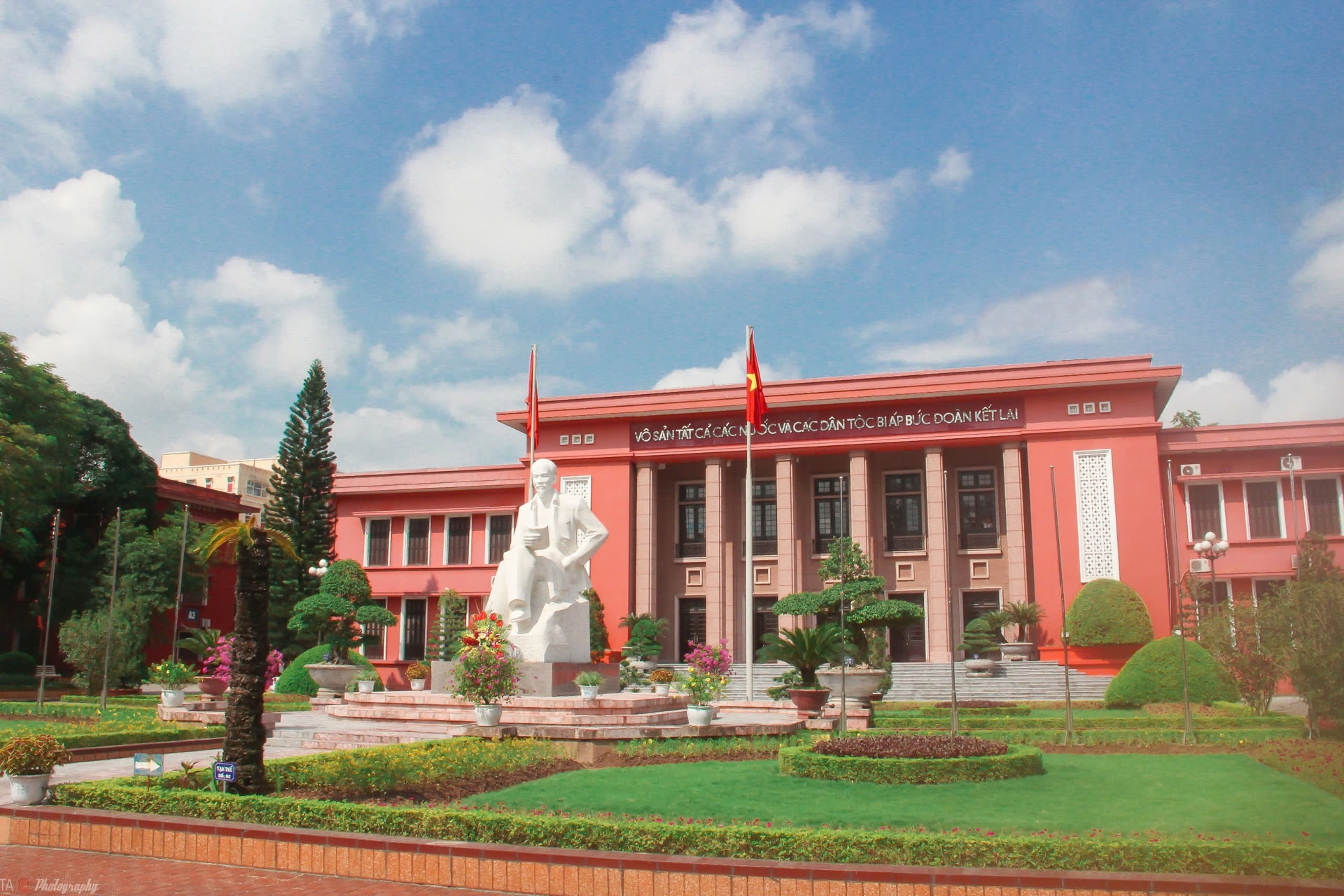
Thanks to its outstanding efforts and contributions, in September 1989, on the occasion of the 40th anniversary of its traditional day, the Academy was honored to be awarded the Ho Chi Minh Medal, a prestigious award, recognizing the great achievements and outstanding contributions by the Academy in its development. Also on this occasion, the Academy inaugurated the statue of President Ho Chi Minh, a sacred symbol, closely associated with the mission of training and fostering cadres at the Academy.
The Academy’s Party Committee leads the organizational consolidation of the apparatus and continues to renovate teaching and research (1993-2007)
March 10, 1993, marked an important event in the development of the Ho Chi Minh National Academy of Politics when the 7th Politburo issued Decision No. 61-QD/TW on the rearrangement of the Central Party Schools into the Ho Chi Minh National Academy of Politics. At the same time, Nguyen Ai Quoc Schools in regions I, II, and III were converted into the Hanoi Branch, the Ho Chi Minh City Branch, and the Da Nang Branch. The Academy of Propaganda was converted into the Academy of Journalism and Communication, under the Ho Chi Minh National Academy of Politics. Subsequently, on February 4, 1997, the Politburo issued Decision No. 166-QDNS/TW, establishing the Party Executive Committee of the Ho Chi Minh National Academy of Politics.
According to Decision No. 61-QD/TW, the Academy came under the Central Executive Committee of the Party and the Government, playing the role of the country’s leading center for training and fostering cadres, and scientific research on political theory for the Party and the State. This decision marked an important transformation, affirming the Academy’s key position and role in the political and educational system of Vietnam.
To enhance capacity in education, training and scientific research, and to integrate the study of Marxism-Leninism and Ho Chi Minh Thought with the work of training and fostering political theory, on October 30, 1996, the Politburo issued Decision No. 07-QD/TW, merging the Institute of Marxism-Leninism and Ho Chi Minh Thought with the Ho Chi Minh National Academy of Politics, forming the Ho Chi Minh National Academy of Politics with expanded functions and responsibilities, to meet the new demands in political theory research and training.
On October 20, 1999, the Politburo issued Decision No. 67-QD/TW on the functions, tasks and organizational structure of the Ho Chi Minh National Academy of Politics. Accordingly, the Academy was identified as a national center for training and fostering cadres and scientific research on behalf of the Party and the State.
To improve the quality of training and scientific research, commensurate with its new functions and tasks, on February 3, 2004, the Academy’s Party Executive Committee issued Resolution No. 04/NQ-BCS, proposing policies and solutions to improve the quality of training and scientific research at the Academy. To implement this resolution, the Director of the Academy issued Decision No. 80/QD-HVCTQG on February 19, 2004, and Decision No. 685/QD-HVCTQG on April 10, 2006, concretizing the goals and measures for executing the Party Committee’s resolution across the entire Academy system, thereby bringing about important and positive changes in its operations.
The leadership role of the Party Committees at the Academy’s central headquarters, branch campuses, and student classes was strengthened. Efforts were focused on recruiting new Party members, especially fostering a younger generation of cadres, and some young cadres were elected to Party committees.
With outstanding achievements in the early period of renovation, on September 22, 2004, on the occasion of the 55th Anniversary of the Academy’s Traditional Day (1949-2004), the Ho Chi Minh National Academy of Politics was honored to be awarded the title of Labor Hero.
Period 2007-2014: Solidarity, bold renovation, and outstanding achievements in cadre training and scientific research
Implementing the Resolution of the 4th Central Conference, Session X, the Politburo issued Decision No. 60-QD/TW dated May 7, 2007, on merging the National Academy of Public Administration and the Ho Chi Minh National Academy of Politics into the Ho Chi Minh National Academy of Politics and Public Administration. According to this Decision, the Academy became a public service unit under the Central Executive Committee of the Party and the Government, under the direct and regular guidance of the Politburo and the Prime Minister.
The Party organization work at the Academy was consolidated and improved, enhancing the leadership role of the Party Committee. In April 2009, the Academy Party Committee was established and became a grassroots Party Committee, directly under the Party Committee of the Central Agencies. In 2009, the Academy Party Committee had 9 subordinate Party Committees and 21 grassroots Party cells. The establishment of a unified Party Committee through the entire Academy system marked an important event, creating synchronous and comprehensive leadership across all aspects of its work.
On September 16, 2010, the first Congress of the Party Committee of the Ho Chi Minh National Academy of Politics and Public Administration for the 2010-2015 term was organized. With the theme “Solidarity, bold renovation, outstanding completion of the task of training, fostering cadres and scientific research, worthy of the academy named after President Ho Chi Minh”, the Congress elected the Party Executive Committee for the new term and directed the consolidation of the Trade Union, the Ho Chi Minh Communist Youth Union, the Veterans Association, following the unified model across the entire Academy system.
The Party committees and cells within the Party Committee of the Academy have promoted their leadership role, built and implemented programs and work plans, successfully completed political tasks, cadre work, and Party building work. The Academy’s Party Committee has directed party organizations in the agency and student sectors to renovate and improve the quality of party activities, promote democracy within the Party, cultivate revolutionary ethics and political mettle, to better meet the requirements and tasks in the new period.
The Party Committee of the Academy directed the grassroots Party Committees to regularly and extensively educate cadres and Party members about raising vigilance, actively fighting against wrong views and distorted arguments on cyberspace and in public opinion. To ensure discipline and seriousness in communicating and circulating documents, the Party Committee emphasized maintaining a firm stance in articles in journals, scientific research works, and classroom lectures.
The campaign to study and follow Ho Chi Minh’s moral example was implemented according to the plan and guidance of the Central Committee. Study sessions on the theme “Building a truly clean, strong Party that embodies morality and civilization” were widely organized among cadres, Party members, civil servants, and students.
From the 2011-2012 academic year, the Academy’s Party Committee has focused on guiding the strict implementation of self-criticism and criticism by the collective and individual leaders of the units under the Academy, in accordance with the spirit of Resolution No. 4 of the 11th Central Committee. Special attention has been paid to the development of new Party members. The Party Committee has organized training courses for candidates for Party membership and new Party members.
The Party Committee of the Academy continuously grows, leading the comprehensive construction and development of the Ho Chi Minh National Academy of Politics (2014 to present)
Following the country’s renovation process, the Politburo, the Central Party Secretariat, and the Government have issued many documents and resolutions, which have had a direct, profound, and comprehensive impact on the activities of the Academy. To implement the Resolutions of the 12th and 13th National Party Congresses, the Academy has promptly supplemented and updated new content in the regulations of the Party and the Government. At the same time, the Academy has issued appropriate regulations and rules, implemented in a unified and synchronous manner across the entire system.
In August 2018, the Politburo issued Decision No. 145-QD/TW on the functions, tasks, powers and organizational structure of the Ho Chi Minh National Academy of Politics. Accordingly, the Academy is an agency directly under the Party Central Committee, operating under the direct, comprehensive and regular leadership and direction of the Politburo and the Secretariat. The requirements placed upon the Academy include a determination to strive and seize all opportunities to carry out comprehensive reforms and improve quality across all areas of work. The Academy must reorganize its apparatus toward streamlining and efficiency, while also focusing on infrastructure development to meet new mission requirements.
The Party Congress of the Ho Chi Minh National Academy of Politics for the 2020-2025 term set forth the motto “Solidarity - Democracy - Discipline - Exemplarity - Creativity - Efficiency”. The Party Committee focused on leading and directing the implementation of key and breakthrough tasks, strengthening system-wide management, ensuring synchronization and promoting the initiative and creativity of Party committees and unit leaders.
The Party Committee and the Party Committee Standing Committee have directed the implementation of comprehensive and synchronous renovation in all stages of work following the motto “fundamental, systematic, practical, modern”, aiming to improve the quality of training and fostering work, contributing to building a team of leaders and managers with sufficient capacity, qualities and integrity, meeting the requirements of tasks in the new period.
Party building work was given special attention, particularly Party building in ethics. The Party Committee directed cadres and Party members to actively participate in contests aimed at learning about the Party’s leadership achievements over 30 years of renovation and in writing contests on studying and following Ho Chi Minh’s thought, ethics, and style.
In addition, building Party organizations and developing Party membership received attention from the Academy’s Party Committee and its subordinate Party Committees and cells. For many consecutive years, the Party Committee of the Ho Chi Minh National Academy of Politics has been assessed by the Standing Committee of the Party Committee of the Central Agencies as a particularly clean and strong Party Committee and a Party Committee that has fulfilled its tasks excellently. For this, it has been awarded a Certificate of Merit for being an exceptionally clean and strong Party Committee.
With its development achievements and great contributions by the Academy to the revolutionary cause of the Party and the nation, on the occasion of the 75th anniversary of its traditional day (1949-2024), the Academy was honored to receive the First-Class Labor Medal.
3. Conclusion
From its early days of establishment and throughout 75 years of construction and development, generations of leaders, cadres, and lecturers of the Academy have understood its role and position as a Central Party School, deeply aware of the importance of building a clean, strong Party Committee and promoting the strength of the political system to carry out political tasks assigned by the Party and the State.
Throughout its operational periods, the Party organizations in the Academy have always effectively performed their leadership roles according to the functions and tasks prescribed by the Party Central Committee. The Academy’s Party Committee has always focused on comprehensive Party building, including political, ideological, organizational, ethical, and personnel aspects. Training, consolidation, appointment, and management of cadres have been prioritized, along with implementation of criticism and self-criticism. The Party Committee has paid special attention to fostering the ethical qualities and lifestyles of cadres, Party members, and students - worthy of the role of cadres and Party members of the Party School.
_________________
Received: December 25, 2024; Revised: December 27, 2024; Approved for publication: December 29, 2024.
Endnotes:
(1), (2) Communist Party of Vietnam: Complete Party Documents, vol. 10, National Political Publishing House, Hanoi, 2001, pp.139, 21.