

Humanistic values in Ho Chi Minh’s thought on democracy
DOI: https://doi.org/10.70786/PTOJ.2026.5226
Abstract: The humanistic values in Ho Chi Minh’s thought on democracy are clearly shown in the principle: "The people are the masters, and the people act as masters". Ho Chi Minh identified the people as the center; all power belongs to the people and serves the people. This is demonstrated through Ho Chi Minh's tireless struggle for national independence and his efforts to create the conditions for the people to truly participate in the decision-making and social management. The humanistic values in Ho Chi Minh’s thought on democracy serves as the compass for the cause of renovation and development of the country, both now and in the future.
Dr. DINH QUANG THANH
Ho Chi Minh National Academy of Politics
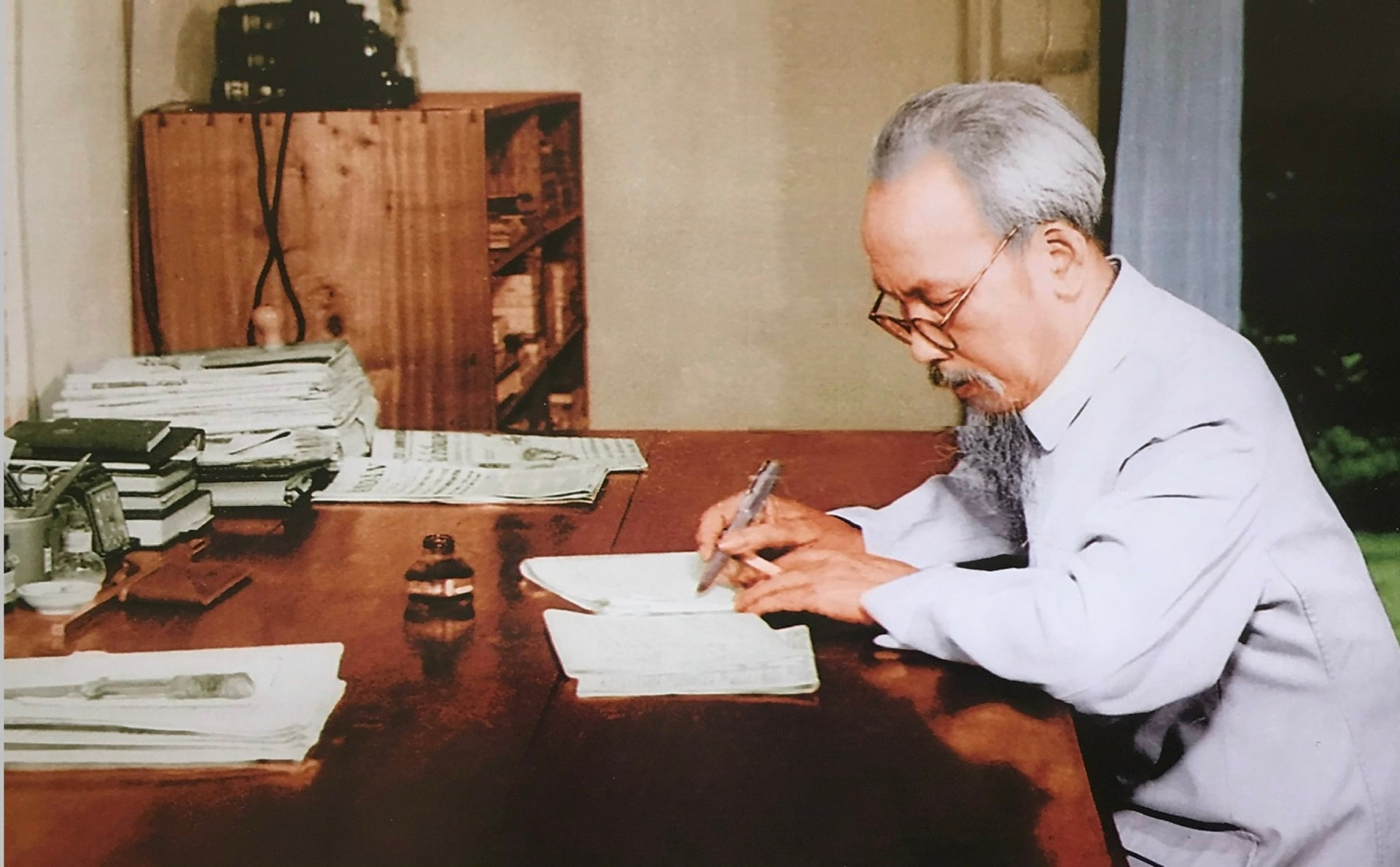
1. Introduction
Ho Chi Minh’s thought on democracy is one of the core components in his comprehensive and profound system of views on the Vietnamese revolution, carrying deeply humanistic values. Throughout his life and great revolutionary career, Ho Chi Minh had only one goal: to “wholeheartedly serve the Fatherland, serve the revolution, serve the people”(1) and to devote his whole life to the cause of human liberation. Ho Chi Minh consistently regarded the people as the center of all decisions, upholding democracy as a fundamental value in the cause of national liberation and building, protecting and developing the country. The humanistic values in Ho Chi Minh’s thought on democracy are not only reflected in respect for, protection of, and promotion of the people’s right to be masters and to exercise that mastery, but also in the pursuit of national liberation, class liberation and, most importantly, the complete liberation of humanity.
2. Content
2.1. Ho Chi Minh’s thought on democracy holds profound humanistic values
In the context of a country in misery and slavery, the patriotic young man Nguyen Tat Thanh left the country to seek a new path to save the country and liberate the nation. Through countless hardships, “hiding in the mountains”, “going in and out of prison”, he and the Communist Party of Vietnam restored the name of Vietnam on the world map, bringing the people of colonial Annam from a state of slavery, to being the masters of an independent and free country. The Declaration of Independence, which he drafted and proclaimed on September 2, 1945, not only affirmed: “All men are born equal. They are endowed by their Creator with certain inalienable rights; among these are the right to life, the right to liberty and the pursuit of happiness”(2), but also “by extension, this sentence means: all peoples in the world are born equal; every people has the right to life, the right to happiness and the right to freedom”(3). Human rights (the right to life, equality, freedom, independence, inviolability, the right to pursue happiness...) belong to all nations, including those nations and people who lost their country and are being oppressed and exploited by the harsh regimes of imperialism and feudalism. Thus, “Vietnam has the right to enjoy freedom and independence, and has in fact become a free and independent country” and “the entire Vietnamese people are determined to devote all their spirit and strength, their lives and property to maintain that freedom and independence”(4) to firmly enter a new era - the era of independence, freedom, and socialist democracy with profound humanistic values that align with the aspirations of the majority of the people.
Inheriting and developing national traditions and the quintessence of humanity, especially the democratic and humanistic ideology of Marxism-Leninism, Ho Chi Minh put forward a viewpoint that was both revolutionary and scientific in nature, while also bearing profound humanistic values with regard to democracy.
Firstly, the humanistic values in Ho Chi Minh’s democratic thought are most clearly expressed in the people’s right to be masters, and to act as masters. According to him, democracy means “the people are masters” and “the people act as masters” - placing the people in the position of social subjects, “the highest position belongs to the people”, “the people are masters”; at the same time, clearly affirming the close, inseparable relationship between the position of the people as social subjects and the people’s actions as masters of society. In the newly established democratic regime, the humanistic values of democracy - the right to democracy is concretized by ensuring human rights and civil rights not only in theory but also in practice. For President Ho Chi Minh, the independence and unification of the Fatherland must go hand-in-hand with the freedom and happiness of the people, because: “If the country is independent but the people do not enjoy happiness and freedom, then independence is meaningless”(5). From the greatest wish in his life: “I have only one desire, the utmost desire, which is to make our country completely independent, our people completely free, everyone has food to eat, clothes to wear, everyone can have access to education”(6). Ho Chi Minh made “his people’s liberation revolution a symbol of freedom, justice and peace in the world. His noble spirit made even his enemies respect and admire him. More than anyone else, he gathered around his name the struggles and hopes of oppressed people all over the world, of young men and women, of all people regardless of faith and ideals, who spoke out against war, violence and imperialism”(7).
Ho Chi Minh’s famous assertion: “Nothing is more precious than independence and freedom”(8) has profound humanistic meaning. It is not only the aspiration of all humanity, a great ideological principle, but also a timeless truth, as it affirms the people’s right to independence and freedom, placing the people at the center of all revolutionary activities. Ho Chi Minh attached great importance to the protection, guarantee, and realization of human rights: from the right to life, to freedom, to the pursuit of happiness, as well as civil, political, and economic rights... This includes the requirement that the State establish and ensure the political rights of the people: “All citizens, male and female, eighteen years old and above, have the right to run for office and to vote, regardless of wealth, religion, or ethnicity”(9); “All Vietnamese people (except traitors deprived of public power) from 18 years of age and above, regardless of gender, rich or poor, Viet Minh or non-Viet Minh, have the right to run for election or to vote for members of these Committees”(10); at the same time, encourage the people to participate in social activities, express their opinions, and make contribution to the process of building, protecting and developing the country (the process of making decisions, managing and supervising the activities of the state apparatus) in the spirit of “regardless of gender, age, rich or poor, religion or belief, regardless of Man, Muong, Meo, etc., together enthusiastically stand up and strive to consolidate the independence of the country and build a foundation of happiness and freedom for the people”(11).
In Ho Chi Minh’s thought, genuine democracy is most humane when state power originates from the people, belongs to the people and reflects the thoughts, aspirations and legitimate interests of the people: “OUR COUNTRY IS A DEMOCRATIC COUNTRY. All benefits are for the people. All powers belong to the people. The work of renovation and construction is the responsibility of the people. The cause of national resistance and construction is the work of the people. The government, from the commune to the central government, is elected by the people. The organizations from the central government to the commune are organized by the people. In short, all power and strength lie with the people”(12). Therefore, in order to build the nation, he not only required the Government to urgently carry out the task of: “ensuring the people have food to eat, ensuring the people have clothes to wear, ensuring the people have residences in which to live, ensuring the people are educated”(13), but also at the same time emphasized “the policy of the Party and the Government is to take utmost care of the people’s lives. If the people are hungry, the Party and the Government are at fault; if the people are cold, the Party and the Government are at fault; if the people are ignorant, the Party and the Government are at fault; if the people are sick, the Party and the Government are at fault”(14).
For Ho Chi Minh, Party and State agencies, cadres and party members not only need to be close to the people, understand their needs and respect their legitimate interests, care for their material and spiritual lives in the spirit of honest service, but also must always thoroughly grasp the position of being both a leader and a “loyal servant” of the people following the motto: “Whatever is beneficial to the people must be done with all our might, whatever is harmful to the people must be avoided at all costs”(15); “cadres of mass organizations as well as the government, from top to bottom, are all servants of the people, and must take the people’s opinions seriously”, and so on(16).
From the above analysis, it becomes clear that there is a close dialectical relationship between “the people are masters” and “the people act as masters” with mutual interaction and complementarity, expressed as follows: Firstly, “the people are masters” is the premise for “the people act as masters”: Once the people have been established as the subjects of the country, their right to mastery must be exercised in reality. If we merely affirm the people’s status as masters without establishing mechanisms to realize this right (i.e., Party leadership, State management, and people’s mastery), democracy remains a formal concept with no substantive meaning. Secondly, “the people act as masters” is the realization of “the people are masters”: The people’s proactive participation in political, economic and social activities is a concrete manifestation of the mastery. If the people do not actually exercise this mastery, then the title of “the people are masters” becomes meaningless. Thirdly, “the people are masters” without “the people act as masters” is formal democracy. On the contrary, “the people act as masters” without “the people are masters” is a distorted democracy: Because if we only declare that the people are masters but do not create conditions for the people to exercise their mastery, it is a formal democracy, not reflecting the true nature of the democratic regime. On the contrary, if the people have the opportunity to exercise their mastery but the government does not truly represent the people, does not serve the people, then democracy will be distorted, leading to injustice and social instability. Therefore, the dialectical relationship between “the people are masters” and “the people act as masters” in Ho Chi Minh’s thought clearly shows the humanistic nature of the socialist democratic regime. The people are masters, establishing the supreme position of the people, and the people are masters is the process of exercising the power of the people in reality. These two principles cannot be separated, but complement and interact with each other, ensuring substantive democracy and sustainable development.
Secondly, the humanistic values in Ho Chi Minh’s democratic thought are reflected in the constant respect for and attention to the people’s opinions. According to him: “To serve the people, one must be close to the people, learn from the people, and listen to the people”(17), “help people, love, respect the people, and learn from the people”(18) and “rely on the people, then anything, no matter how difficult it is, can be done”(19). Therefore, being close to the people, respecting the people, loving the people, learning from the people, and relying on the people means properly understanding the idea that “the people are the root”. It also means implementing the motto “the people know, the people discuss, the people do, the people inspect, the people supervise, and the people benefit”(20) in all Party and State activities in accordance with Ho Chi Minh’s thought. This not only ensures that all policies, development programs and “all branches of literature, art, cinema, music, dance, theater, painting... must be popularized and democratized”(21) to serve the people but also ensures the active participation of the people throughout the process, from planning to implementation, monitoring and benefiting.
Thirdly, socialist democracy and the people’s happiness are the goals and driving forces behind national development. In Ho Chi Minh’s thought: “Socialism is about making the people prosperous and the country strong”(22); “everyone is well-fed, warmly clothed, happy and free”(23); “society is increasingly progressive, material conditions are increasingly abundant, and the spirit is continually improved”(24); and the regime our people are building is “a society without exploitation of man by man, an equal society, meaning that everyone must work and has the right to work, whoever works a lot gets a lot, whoever works less gets less, and those that do not work do not enjoy the benefits”(25). In such a society, all Party and the Government policies on economics, culture, social security, national security, national defense, foreign affairs... are planned and implemented synchronously to continuously improve the material and spiritual life of the people. At the same time, “it is ensured that democracy is practiced in real life at every level, in all areas. Democracy is closely linked to discipline and order and must be institutionalized and guaranteed by law”(26).
The humanistic values in Ho Chi Minh’s thought on democracy - “socialist democracy is the essence of our regime, both the goal and the driving force of national development”(27) are also reflected in creating an environment for all people to have the opportunity to develop comprehensively. That is “the free development of each person is the condition for the free development of all people”(28) and “all people are able to develop to their full potential”(29); and “each person has the conditions to improve his or her own life, promote his or her own personality and strengths”(30).
In reality, the people’s mastery is the essence and core of socialist democracy. Therefore, Ho Chi Minh not only focused on ensuring and promoting their mastery but also affirmed the requirement to promote the role of the people in participating in building the Party, building a clean and strong government and political system in the spirit of “properly and effectively implementing direct democracy, representative democracy, especially democracy at the grassroots level”(31). This is the thesis that most focuses and prominently demonstrates the democratic and humanistic ideology of Marxism-Leninism. Accordingly, not only is the free development of each person a condition for the free development of all people, but the free development of the individual can only be realized when society is liberated from all forms of oppression and exploitation, slavery and alienation.
Ho Chi Minh’s thought on democracy not only emphasizes rights but also defines the obligations and responsibilities of citizens in complying with discipline and the law. According to him: “Our country is a democratic country, meaning that the country is owned by the people. The people have the right to be masters, so they must fulfill their civic duties and uphold civic ethics”(32); which means “the people have the duty to help the Government, follow the Government’s discipline and follow the Government’s policies, so that the Government can fulfill the duties that the people have entrusted to it”(33). Furthermore, the people not only have the right to be the masters of the state: “Each citizen must understand that he is the master of the country, must fulfill the duties of the master, that is, must strive to increase production and practice thrift, contributing worthily to the cause of building socialism to gradually improve the material and cultural life of the people, so that future generations will forever be warm, prosperous and happy”(34); they must also fulfill the duties of a citizen, preserve and protect civic ethics such as obeying the law; labor discipline; maintaining public order; paying taxes on time and in the right amount; enthusiastically participating in public work; protecting public property; protecting the Fatherland as well as improving the material and spiritual life for the present and for future generations.
2.2. Applying and promoting humanistic values in Ho Chi Minh’s thought on democracy
Ho Chi Minh’s democratic thought not only selectively absorbed the humanistic and democratic values of Marxism-Leninism and the West, but also blended them with the humanistic, ethical, cultural and historical values of the Vietnamese people and the East, creating a system of humanistic and democratic thought that is both contemporary and deeply imbued with national identity. The origin of Ho Chi Minh’s thought on democracy is the human being - originating from a deep love for humanity, from the historical and cultural traditions of the nation. Therefore, the humanism in his thought on democracy is not only clearly shown in the fact that all the Party’s guidelines, policies, the State’s policies and laws are for the people - placing the people at the center and as the driving force for development - but is also deeply rooted, with enduing vitality, aimed at the comprehensive development and total liberation of the human being.
Ho Chi Minh’s thought on democracy is one of the important foundations in the cause of building, protecting and developing the country along the socialist path. The humanistic values in his democratic thought is not only reflected in considering democracy as a right a right of the people, but also as the driving force for the comprehensive development of society. In the current context, that thought holds great practical significance, long-term orientation and is the compass for building socialist democracy in our country. Specifically:
Firstly, it is the foundation and guideline for building and perfecting the socialist rule-of-law state of the people, by the people, for the people
Deeply imbued with Ho Chi Minh’s thought, during the renovation period, our Party’s understanding of the renovation of the political system has become increasingly comprehensive and complete. In particular, the transition from the model of a proletarian dictatorship state to building a socialist rule-of-law state of the people, by the people, for the people under the leadership of the Communist Party of Vietnam is a breakthrough. At the 13th National Congress, among the twelve major orientations to promote socio-economic development to 2030, with a vision to 2045, the Party affirmed: “Build and perfect a clean, strong, streamlined, effective and efficient socialist rule-of-law State, serving the people and the development of the country. Strengthen publicity, transparency, accountability, and control of power in conjunction with tightening discipline and order in the activities of the State and of cadres, civil servants, and public employees. Continue to promote the fight against corruption, wastefulness, bureaucracy, crime, and social evils”(35). This marks a major step forward in the Party’s and State’s recognition of the vital role of building a rule-of-law State of the people, by the people and for the people in realizing the socio-economic development goals up to the 100th anniversary of the founding of the Communist Party of Vietnam (2030) and the vision up to the 100th anniversary of the founding of the Democratic Republic of Vietnam, now the Socialist Republic of Vietnam (2045).
Secondly, continue to promote the people’s mastery to build a clean, strong, streamlined political system that operates effectively and efficiently, serving the people and the country’s development
According to Ho Chi Minh, “practicing democracy is the universal key that can solve all difficulties”(36); therefore, promoting the people’s mastery in building a clean and strong Party and political system is an urgent requirement to ensure transparency, fight corruption, wastefulness and build a civilized, professional public administration that serves the people effectively... Drawing from the lesson that “in all Party and State work, we must always thoroughly grasp the view that ‘the people are the root’; truly trust, respect, and promote the people’s mastery; persistently implement the motto ‘the people know, the people discuss, the people do, the people inspect, the people supervise, the people benefit,’” as stated at the 13th Congress, we see that the entire political system must internalize the principle that “the people are the root”. From this, not only must the creativity and support of the people be mobilized, but their legitimate rights and interests must also be respected and protected; at the same time, the people must be encouraged to speak up, to express their opinions and views in the spirit of the Law on Grassroots Democracy Implementation No. 10/2022/QH15 dated November 10, 2022, issued by the National Assembly. Especially since the people are the center and the subject of the renovation, construction and protection of the socialist Vietnamese Fatherland, all policies and guidelines of the Party and the State must originate from the real life, from the aspirations, rights and legitimate interests of the people in the spirit of taking the happiness and prosperity of the people as the goal. At the same time, “strengthen the close relationship between the Party and the people, rely on the people to build the Party; consolidate and strengthen the people’s trust in the Party, the State and the socialist regime”(37).
Thirdly, promote sustainable socio-economic development and respect and protect human rights
Democracy is not only a political principle but also a decisive factor for the sustainable development of a country. People are at the center of all development policies; therefore, when people are empowered, they will be motivated to actively participate in the process of socio-economic development. In practice, countries with strong democracies often achieve more stable development by ensuring the rights of the people, encouraging renovation, and economic development based on the foundation of fairness and transparency. Currently, improving the effectiveness and efficiency of state management at all levels in focusing on directing, operating, and organizing the successful implementation of economic, cultural, and social security development goals... to continuously improve the material and spiritual life of the people, while “continuing to build a democratic, professional, modern, streamlined, effective, efficient administration with the capacity to create development, integrity, and serve the people” according to Resolution No. 76/NQ-CP in 2021 on the Overall Program of State Administrative Reform for the 2021-2030 period issued by the Government is the practical realization of Ho Chi Minh’s democratic ideology. That is, “on the basis of promoting widespread democracy, the draft documents are truly the product of the crystallization of the wisdom of our entire Party, people and military, clearly demonstrating the unity between “the Party’s will and the people’s heart”, harmonizing with the determination and will of the entire nation in building and firmly defending the socialist Vietnamese Fatherland..., making our country increasingly prosperous; our people increasingly happy and well off; and our nation increasingly strong and enduring”(38).
One of the core values of democracy in Ho Chi Minh’s thought is to ensure human rights. He emphasized that democracy must go hand in hand with the protection and promotion of basic human rights, including the right to study, work, health care, and comprehensive development in both material and spiritual aspects, etc. In fact, the Party and the State of Vietnam not only strive to build and perfect the institutions and legal frameworks to ensure and promote human rights but also promote international cooperation in the field of human rights and participate in implementing international commitments on human rights. That is not only a reflection of Ho Chi Minh’s thought on democracy and the humanistic meaning of democracy in his thought, but also clearly demonstrates Vietnam’s determination and effort to ensure universal human rights for the Vietnamese people and citizens.
In the current context, ensuring human rights does not stop at policies and laws, but also requires improvements in living conditions, improving the quality of education, healthcare and working environment..., contributing to “the comprehensive human development and building an advanced Vietnamese culture with strong national identity(39), creating a fair, humane and sustainably developed society.
3. Conclusion
The humanistic values in Ho Chi Minh’s thought on democracy are a solid foundation and a compass for the country’s development on the journey of building, protecting, and developing a rich and prosperous country under the leadership of the Communist Party of Vietnam in the new era. Thoroughly understanding and applying his thought into practice in the most concrete and vivid way is the responsibility of all Party committees and grassroots organizations - at all levels of the political system, from central to local, as well as of the contingent of cadres, Party members, civil servants, and public employees. They must be exemplary in practicing democracy, ensuring consistency between words and actions in the performance of public duties and in everyday life - not only complying with the law and upholding social ethics, but also becoming typical examples of democracy, practicing socialist democracy in all areas of social life.
_________________
Received: March 10, 2025; Revised: March 18, 2025; Approved for publication: March 20, 2025.
Author e-mail: dinhquangthanh@gmail.com
Endnotes:
(1), (8), (36) Ho Chi Minh: Complete Works, vol.15, National Political Publishing House, Hanoi, 2011, pp.623, 130, 325.
(2), (3), (4), (5), (6), (9), (10), (11), (13), (15), (28), (29) Ho Chi Minh: Complete Works, vol.4, ibid., pp.3, 3, 3, 64, 187, 7, 12, 67, 175, 51, 628, 315.
(7) The world praises and mourns President Ho, vol.II, Publishing House, Hanoi, 1976, p.99.
(12), (17) Ho Chi Minh: Complete Works, vol.6, ibid., p.232, 370.
(14), (18), (32), (33) Ho Chi Minh: Complete Works, vol. 9, ibid., p. 518, 59, 258, 90.
(16), (19), (22), (23) Ho Chi Minh: Complete Works, vol. 10, ibid., p. 414, 47, 390, 593.
(20), (31), (35), (37), (38), (39) CPV: Documents of the 13th National Party Congress, vol.I, National Political Publishing House, Hanoi, 2021, tr.27, 173, 118, 27-28, 19-20, 37.
(21), (25), (30), (34) Ho Chi Minh: Complete Works, vol.11, ibid., p.474, 241, 610, 486.
(24) Ho Chi Minh: Complete Works, vol.13, ibid., p.438.
(26), (27) CPV: Documents of the 11th National Party Congress, National Political Publishing House, Hanoi, 2011, p.85, 84-85.